Sunday, March 14, 2010

The Secret to Having Happy Employees

by Jay Goltz
Thursday, March 11, 2010


About 10 years ago I was having my annual holiday party, and my niece had come with her newly minted M.B.A. boyfriend. As he looked around the room, he noted that my employees seemed happy. I told him that I thought they were.

Then, figuring I would take his new degree for a test drive, I asked him how he thought I did that. "I'm sure you treat them well," he replied.

"That's half of it," I said. "Do you know what the other half is?"


He didn't have the answer, and neither have the many other people that I have told this story. So what is the answer? I fired the unhappy people. People usually laugh at this point. I wish I were kidding.

I'm not. I have learned the long, hard and frustrating way that as a manager you cannot make everyone happy. You can try, you can listen, you can solve some problems, you can try some more. Good management requires training, counseling and patience, but there comes a point when you are robbing the business of precious time and energy.

Don't get me wrong. This doesn't happen a lot. There's no joy in the act of firing someone. And it's not always the employee's fault — there are many bad bosses out there. Bad management can make a good employee dysfunctional. On the other hand, good management will not always make a dysfunctional employee good. And sometimes people who would be great employees somewhere else just don't fit your company, whether it is the type of business or the company culture.

In the worst cases, the problem of a bad fit can have a bigger impact than just one employee's performance. Being in charge does not necessarily mean you are in control, and being in control does not necessarily mean being in charge. Have you ever seen a company or department paralyzed by someone who is unhappy and wants to take hostages? It is remarkable how much damage one person can do. If you haven't seen it, I suggest you watch "The Caine Mutiny." Basically, one guy takes apart the ship. He was unhappy. It only takes one.

This is only my opinion. I don't have a Ph.D., an M.B.A., or even an economics degree. What I do have is a happy company. And that makes me happy. Now I know some people argue that business is about making money, and not everyone has to be happy. That is also an opinion. Everyone has a right to his or her opinion. When you own a company, you also have the right to surround yourself with the people you choose.

I have spent the last year and a half focusing on cutting costs, figuring out how the market has changed, and worrying about the economy. Things seem to be getting better, or perhaps I am just getting used to it.

Either way, I had a good day today. Not because I got a big order, great financial reports or even an employee stopping by to tell me what an awesome boss I am. (That generally doesn't happen. You have to tell yourself. It's a boss thing.) I had a great day because I spent most of it walking around the company and appreciating the fact that even after a year and a half of soft sales and cutbacks and furloughs, I have wonderful people working for me. They care. They are committed. They understand the whole customer–staff–company triangle, where all of the legs support each other.

If you read books on great companies, they usually leave out a dirty little secret. It doesn't make for good public relations — like talking about how you "empower people" or how your "greatest assets" are your people. Both of these well–worn clichés are true. What is also true is that it's hard to build a great company with the wrong people.

When you have the right people, business is much easier. I know because I have tried it both ways.

Jay Goltz owns five small businesses in Chicago.

Tuesday, March 09, 2010

Clifford Stoll's 1995 Internet predictions (from Newsweek)

The Internet? Bah!

Hype alert: Why cyberspace isn't, and will never be, nirvana

This is hilarious! It just goes to show how hard it is to predict the future and how your predictions can come back to haunt you. Thanks a lot, Clifford. I really enjoyed this.

By Clifford Stoll NEWSWEEK
From the magazine issue dated Feb 27, 1995

After two decades online, I'm perplexed. It's not that I haven't had a gas of a good time on the Internet. I've met great people and even caught a hacker or two. But today, I'm uneasy about this most trendy and oversold community. Visionaries see a future of telecommuting workers, interactive libraries and multimedia classrooms. They speak of electronic town meetings and virtual communities. Commerce and business will shift from offices and malls to networks and modems. And the freedom of digital networks will make government more democratic.


Baloney. Do our computer pundits lack all common sense? The truth in no online database will replace your daily newspaper, no CD-ROM can take the place of a competent teacher and no computer network will change the way government works.

Consider today's online world. The Usenet, a worldwide bulletin board, allows anyone to post messages across the nation. Your word gets out, leapfrogging editors and publishers. Every voice can be heard cheaply and instantly. The result? Every voice is heard. The cacophany more closely resembles citizens band radio, complete with handles, harrasment, and anonymous threats. When most everyone shouts, few listen. How about electronic publishing? Try reading a book on disc. At best, it's an unpleasant chore: the myopic glow of a clunky computer replaces the friendly pages of a book. And you can't tote that laptop to the beach. Yet Nicholas Negroponte, director of the MIT Media Lab, predicts that we'll soon buy books and newspapers straight over the Intenet. Uh, sure.

What the Internet hucksters won't tell you is tht the Internet is one big ocean of unedited data, without any pretense of completeness. Lacking editors, reviewers or critics, the Internet has become a wasteland of unfiltered data. You don't know what to ignore and what's worth reading. Logged onto the World Wide Web, I hunt for the date of the Battle of Trafalgar. Hundreds of files show up, and it takes 15 minutes to unravel them—one's a biography written by an eighth grader, the second is a computer game that doesn't work and the third is an image of a London monument. None answers my question, and my search is periodically interrupted by messages like, "Too many connectios, try again later."

Won't the Internet be useful in governing? Internet addicts clamor for government reports. But when Andy Spano ran for county executive in Westchester County, N.Y., he put every press release and position paper onto a bulletin board. In that affluent county, with plenty of computer companies, how many voters logged in? Fewer than 30. Not a good omen.

Point and click:
Then there are those pushing computers into schools. We're told that multimedia will make schoolwork easy and fun. Students will happily learn from animated characters while taught by expertly tailored software.Who needs teachers when you've got computer-aided education? Bah. These expensive toys are difficult to use in classrooms and require extensive teacher training. Sure, kids love videogames—but think of your own experience: can you recall even one educational filmstrip of decades past? I'll bet you remember the two or three great teachers who made a difference in your life.

Then there's cyberbusiness. We're promised instant catalog shopping—just point and click for great deals. We'll order airline tickets over the network, make restaurant reservations and negotiate sales contracts. Stores will become obselete. So how come my local mall does more business in an afternoon than the entire Internet handles in a month? Even if there were a trustworthy way to send money over the Internet—which there isn't—the network is missing a most essential ingredient of capitalism: salespeople.

What's missing from this electronic wonderland? Human contact. Discount the fawning techno-burble about virtual communities. Computers and networks isolate us from one another. A network chat line is a limp substitute for meeting friends over coffee. No interactive multimedia display comes close to the excitement of a live concert. And who'd prefer cybersex to the real thing? While the Internet beckons brightly, seductively flashing an icon of knowledge-as-power, this nonplace lures us to surrender our time on earth. A poor substitute it is, this virtual reality where frustration is legion and where—in the holy names of Education and Progress—important aspects of human interactions are relentlessly devalued.

STOLL is the author of "Silicon Snake Oil--Second Thoughts on the Information Highway," to be published by Doubleday in April.

© 1995

The Dream Drain


by David Mitchell

On the eve of departing, a novelist reflects on the pitfalls and perks of Japan.


An expatriate's relationship with the host country is a shifting one, and during my eight years in Western Japan, I have run the whole gamut: Greenhorn-in-Wonderland, hyper critic, "Excuse-me-but-you're-standing-in-my-Japan," culture-intoxicatee. I am returning to the U.K. at the end of March, but, paradoxically, my tie with Japan is due to grow much stronger in mid-May when my wife gives birth and I become the father of an infant Japanese-Briton.
This prospect changes everything. Many long-term western expatriates in Japan inhabit an Edenic state of bourgeois affluence with no strings attached. We enjoy a comfortable lifestyle, yet remain untroubled by civic duties. We can't vote, we may lack linguistic fluency, our opinions are presumed to derive from our national stereotypes, we rarely blip on the national radar, so we are absolved from caring overly about where we live. Japan's problems, except in a Japanwatching way, are not our problems. However, as someone who intends to return in five years to put a child through Japan's elementary-school system, the country's failings suddenly matter more.

My sharpest worry is that national homogeneity continues to be Japan's modern religion. There are no degrees of citizenship here: if you are not "a Japanese" your gaijin status is hammered home at every encounter with officialdom, every gape from rural school kids and every well-meant compliment on your chopstick skills. This is not an "Expat-as-Victim" article: I know that in the immigration authority's hierarchy of gaijinhood, Caucasians have a far easier time than, say, Filipino "Japayukis," Russian exotic dancers or South American laborers. My point is that foreignness is like a magical garment from a folktale, one with the sewn-in curse that its wearers cannot remove themselves. Only social consent will allow my child to feel at home in his or her Asian mother-country.

Japan withholds this consent like a zealot withholds an admission of doubt. At the political level there is no provision for dual nationality in adulthood, so on his or her twentieth birthday our child must go through the ritual of renouncing British citizenship in the eyes of Japanese law�while retaining both European Union and Japanese citizenship in the eyes of British law. On a civic level, even Hiroshima, my home for eight years and, according to its tourist literature "the international city of peace," denies Korean conscripts killed in the A-bomb blast a monument in Peace Memorial Park because its foreign presence would sully the sanctum's purity. "Internationalization," as oft-quoted a mantra here as anywhere, means little on street level beyond flag-bunting, expressway signs in English and more Starbucks franchises.

The sea-change necessary to update Japanese society's relationship with the rest of the world and its peoples is not on the horizon, not yet. Gerontocracy keeps younger talent away from powers of decision making, resulting in a US-bound brain drain, a Europe/New York City-bound arts drain, and, more depressing for a father-to-be, a "dream drain": a pervasive acceptance that a creative and fulfilled life in a human-friendly environment lies only in the Paris of Am�lie, the Rome of Audrey Hepburn's Holiday and the Canada or Hawaii of Japan Travel Bureau brochures. An economy gnawed by deflation produces a climate where xenophobia heats up, not cools down. Education should propagate multiculturalism but instead fosters cookie-cutter conformity in a marathon sprint to brand-name universities which offer a woefully shoddy product. If my wife and I have a daughter, she may well need to sacrifice all hope of a rewarding career should she elect to stay in a Japan as sexist as it is now. The political forces that steered Japan to global dominance in the 1980s are now too dead to kickstart the country back to life, but not dead enough to roll over, expire, and allow their 21st century successors to take over.

This pessimism may be too murky. Japan changes more by revolution than evolution. The Meiji Restoration of 1868 catapulted Japan into the industrial age in the blink of a historian's eye, as did the post-war economic "miracle"�a word employed by Western commentators who failed to see rapid growth coming. It may be that the demographic and financial meltdowns Japan faces will trigger another volcanic transition, and soon. It may be that this change will promote meritocracy, protect the environment, modernize the economy, strangle the Yakuza, muzzle corruption and, crucially for my family's future, usher in a broader definition of what it is to be Japanese. I hope so. I have a strong affection for our child's Asian homeland, an affection that I want him or her to share as a native and not a curio. "Ah, so your child will be a Half," I was told by my colleagues when they learned of my wife's pregnancy. "No," I said, "my child will be a Both."

Thursday, February 11, 2010

Mimi switch

Nudge and wink may turn on all your gadgets


A wink, a smile or a raised eyebrow could soon change the music on your iPod or start up the washing machine, thanks to a new Japanese gadget.

The device looks like a normal set of headphones but is fitted with a set of infrared sensors that measure tiny movements inside the ear that result from different facial expressions.

The gizmo - called the "Mimi Switch" or "Ear Switch" - is connected to a micro-computer that can control electronic devices, essentially making it a hands-free remote control for anything.

"You will be able to turn on room lights or swing your washing machine into action with a quick twitch of your mouth," said its inventor, Kazuhiro Taniguchi of Osaka University.

"An iPod can start or stop music when the wearer sticks his tongue out, like in the famous Einstein picture. If he opens his eyes wide, the machine skips to the next tune. A wink with the right eye makes it go back.

"The machine can be programmed to run with various other facial expressions, such as a wriggle of the nose or a smile."

The Mimi Switch could also store and interpret data and get to know its user, said Taniguchi, chief researcher at Osaka University's Graduate School of Engineering Science in western Japan.

"It monitors natural movements of the face in everyday life and accumulates data," Taniguchi told AFP in an interview. "If it judges that you aren't smiling enough, it may play a cheerful song."

Some may use the device for relaxation - perhaps by changing music hands-free while reading a book - but Taniguchi said it could also have more serious applications to make people's lives safer and easier.

"If the system is mounted on a hearing aid for elderly people, it could tell how often they sneeze or whether they are eating regularly," he said.

"If it believes they are not well, it could send a warning message to relatives."

The device could also serve as a remote control for appliances for physically disabled people, from cameras and computers to air conditioners, or alert medical services if a person has a fit, he said.

The Ear Switch follows on from an earlier device called the Temple Switch that was small enough to fit inside a pair of eyeglasses and also read the flick of an eyelid.

"As the ear switch is put in the ears, its optical sensors are unaffected by sunlight," Taniguchi said.

He said he was planning to patent his new device in Japan and abroad, work on a wireless version, and seek corporate funding to market it for practical uses -- something he expected might take two or three years.

Wednesday, April 02, 2008

Captcha these

Prove that you're human by reading, decoding and then input the following...


Saturday, February 09, 2008

2008/01/26

Hppy on the job...

Have a look and see what you think...

Handling tough meetings...


How to make a tough meeting a win

Marshall Goldsmith: Well, the first thing is: Shut up and listen. Don't prove the other person is wrong. If you disagree, it's OK. You just say, "You believe X, I believe Y. We disagree." Don't get angry. Don't get emotional, don't personalize the dialogue. And focus on what you can change, not what you cannot change.

Is the person your peer, your boss, whatever. If the person is your boss, just say, "Boss, you did X." The boss says, "I want you to do Y." Say, "OK, here's why I did X." You present your case, you try to sell. Your boss says, "I still want you to do Y. Let's talk about how to make Y work."

If it's your peer, then you have to figure out, well, is this the battle I want to fight with my peer? Is it important, is it meaningful or not? If it's a big deal, you know what? Then fight the battle. If it's not a big deal, take a deep breath and let it go.

Whatever happens, though, you go to that meeting...peace. And you try to walk out of that meeting just to achieve results. You don't turn the meeting into a contest about who's smarter or better than the other person.

Winning in business

Succeed more by winning less

You didn't get this far at work without picking up a few bad habits. Lose them, says top executive coach Marshall Goldsmith.

Interview by Eric Schurenberg, Money Magazine managing editor

marshall_goldsmith_full.03.jpg
Executive coach, Marshall Goldsmith

(Money Magazine) -- You can think of executive coach Marshall Goldsmith's job as a kind of workplace public service: He teaches bosses how to stop being jerks. It's a growth business.

The introduction to his book "What Got You Here Won't Get You There" (a No. 1 business bestseller last year) is crowded with quotes from corporate brass - including the CEOs of Ford, Herman Miller and GlaxoSmithKline - testifying to the transformations he wrought on colleagues whose prickly, overbearing or blustery personal styles threatened to stunt their careers and drive away talented underlings.

The Goldsmith cure starts with something like a ritual act of atonement in which the errant manager seeks feedback from his staff about his shortcomings, apologizes and then asks for their help in getting better. Learning what coworkers really think tends to shock the exec into reforming. If it doesn't, Goldsmith's own relentlessly cheerful and studiously nonjudgmental chiding generally finishes the job.

In a recent interview with Money Magazine managing editor Eric Schurenberg, Goldsmith discussed how high achievers can make life more pleasant for all around them - and in the process, improve their own career prospects.

Question: You're usually dealing with top executives. If they're already that successful, why do they need your help?

A. All my clients are intelligent, successful people, just like your readers. But that makes them that much more likely to fall for what I call the success delusion. It goes like this: "I am successful. I behave this way. Therefore, I am successful because I behave this way."

Wrong. You succeed because you do many things right and in spite of a few things you do that are stupid. I've never met anyone so wonderful he had nothing on the "in spite of" list. The problem with the success delusion is that it's superstitious. Any person - any animal, for that matter - will keep doing whatever receives positive reinforcement. If you think you're being rewarded for the stupid things too, you'll keep doing them, even though they hurt your career and make your co-workers miserable.

Question: What stupid things do smart people do?

A. The No. 1 bad habit is, they win too much. It is very hard for them not to win. If it's important, they want to win. If it's trivial, they still want to win. Even if it's not worth it, they want to win anyway.

Question: What's a workplace example?

A. Let's say I'm your enthusiastic subordinate and I report to you with a great idea. Rather than saying "Great idea," you say "Nice idea, why don't you add this?" What happens? The quality of my idea may go up 5 percent, but my commitment to it may now go down 50 percent. It's no longer my idea! You won - you got to show off how smart you are - but it wasn't worth it.

Question: So what should you say when someone pitches an idea?

A. Say "Thank you!" That's all. Let's assume I'm that enthusiastic subordinate again and I give you three ideas. To the first you say "Great idea!" Second: "That's interesting." Third: nothing.

What message did you give me? A, C, F. Are you listening to my ideas or grading them? And what have I learned? From now on I'm going to give you only the ideas I think you want to hear, which may be the last ones you need to hear.

Question: Okay, so how can subordinates manage up better?

A. There's one basic concept that people don't get. If they did, it would save a lot of misery. It's this: Every decision is made by the person who has the power to make it. Not the smartest person, not the prettiest or the best, but the one who has the power.

You can influence that person, but you have to think like a salesperson. Sell what you can sell. If there's no chance to sell an idea, don't bring it up. Focus on the bigger picture, not your own needs. Prepare for objections. If you sell it, great. If you don't, make peace with the decision. And if that decision doesn't require you to do something illegal, immoral or unethical, just salute the flag and go make it work.

Question: If you had to choose one piece of advice that would help people achieve more happiness on the job, what would it be?

A. Imagine that you're 95 years old, on your deathbed. But before you take that last breath, you get a wonderful gift: the ability to go back in time and talk to the younger you who's reading this story right now and help that younger you have a better career and, more important, a better life.

What would that wise 95-year-old tell you to do? Now listen closely because this is the best bit of career coaching you're ever going to get: Whatever you think that 95-year-old would urge you to do, do it. Starting now. When the time comes, you want that 95-year-old to be proud of you. If he says you were a success, you were.

Trust me, of all the performance appraisals you'll ever have, that's the only one that really matters.

Thursday, October 25, 2007

Travel Troubles?.....


How to complain when things go wrong
Say something—but the right way. Experts and readers weigh in
By Laura MacNeil
There's nothing new here if you're a seasoned traveler, but all of the advice is practical; it seems effective and worth keeping in mind.

Stage one: When it happens

Act quickly
Say you're at a hotel and the air-conditioning is feeble or a lightbulb is out. Contact the front desk immediately. If the representative can't or won't remedy the situation, place a call to the company's toll-free customer-service number or, better yet, the frequent-guest rewards program (you did join, right?). When a Holiday Inn in Salem, Va., told Michaelene McWhinney, a BT reader from Greensburg, Pa., that it was out of hangers, McWhinney got in touch with Priority Club customer service. "We had hangers delivered to us within an hour," she says.

Control your emotions
"I can tell you that, hands down, being polite and reasonable when you complain will get you the farthest," says an airline reservation agent who prefers to remain anonymous. "My coworkers and I often talk about how we dig our heels in when someone talks down to us, screams, swears, or threatens us." Bear in mind that you want action, not simply a chance to vent. "If customer-service employees think there's nothing they can do to make you happy, they won't bother," says David Rowell, publisher of The Travel Insider Web site.

The goal is to be firm and clear, without coming off as insulting or aggressive. Maintain your cool throughout all correspondence: Reps will be noting in your record how you behave, so there's little use in turning on the charm after a history of tirades.

Build a case
Keep track of the names of anyone you speak with and the chronology of events. Hold onto receipts, estimates, confirmation numbers, and brochures. You never know when the info will come in handy. Simply noting what the rep was wearing can help. If the behavior of a Continental Airlines staffer is in question, for instance, the airline will want to know if he or she was wearing a red jacket, which distinguishes customer-service representatives from other personnel.

Companies say that having photos to accompany your complaint is unnecessary, and probably won't affect their final decision. If it comes down to your word versus an employee's, however, the right photo just might tilt the outcome in your favor. Certainly, no company wants a photograph painting it in a bad light circulated on a Web site or anywhere else.


Stage two: When there's no quick fix

Take a smart approach
If you used a travel agency, it should work as your advocate before, during, and after the trip. But the responsibility of badgering a company often falls to the customer. While corresponding with a company by letter or e-mail is time-consuming, calling can be frustrating in a different way—you may have to repeat the same story as you're passed along from one employee to another. Often, the issue isn't resolved with a single call.

Include relevant facts
Don't give the company an excuse for dragging its feet in making a decision. Always include your name, address, and phone number, as well as the reservation number, how the reservation was made, and the dates and places involved. You don't have to write a cohesive essay; bullet points will do the job fine.

Try flattery
It never hurts to note the great experiences you've previously had with the company. If you're a member of that company's rewards program, say so. "Mention the overall business you've given them," says BT reader Marie Wilson, of San Carlos, Calif. "If you've logged 50,000 miles with an airline or stayed a lot of nights at that hotel chain, the company will want to know."

Be open-minded about compensation
"I let the agent come up with a solution, rather than demand something specific," says Lesley Woodward, a reader from Kailua-Kona, Hawaii. "His or her offer is sometimes better than I could imagine. If it isn't acceptable, I ask for alternatives." Most companies are extremely reluctant to hand out cash. "If your flight is overbooked, you can ask for a ticket on the next flight out and an upgrade," says Chicago reader Concetta Phillipps. Discounts and vouchers for future bookings with the company are also fairly easy to come by.

Stage three: Following up

Be persistent
Whenever you're not satisfied, press your case with someone else. Call back and try your luck with a different representative, or ask to speak to a supervisor. "If there's nothing else that the manager can offer, ask for the name and number of the district manager," says BT reader Ruthann Galarza of Milwaukee.

Go public
Newspaper travel sections and Budget Travel and other travel magazines want to hear about consumer experiences—especially instances of fraud. They can sometimes shame a company into giving you what you want.

File a complaint with consumer-affairs departments or, in the case of airlines, the Aviation Consumer Protection Division. The agencies are rarely able to intercede, but at least there will be an official record of your dissatisfaction. If you want to warn other travelers, post a note at a user-review site like Epinions or TripAdvisor. The companies we spoke to say such entries don't make a difference in how they resolve complaints. Many companies won't even admit to looking at these sites—which is silly, because potential customers certainly are.

Tuesday, September 11, 2007

Future intelligence


What will happen when machines outthink us?
At Singularity Summit, futurists say now is the time to plan our strategy
By Marcus Wohlsen


SAN FRANCISCO - At the center of a black hole there lies a point called a singularity where the laws of physics no longer make sense.

In a similar way, according to futurists gathered Saturday for a weekend conference, information technology is hurtling toward a point where machines will become smarter than their makers. If that happens, it will alter what it means to be human in ways almost impossible to conceive, they say.

"The Singularity Summit: AI and the Future of Humanity" brought together hundreds of Silicon Valley techies and scientists to imagine a future of self-programming computers and brain implants that would allow humans to think at speeds nearing today's microprocessors.

Artificial intelligence researchers at the summit warned that now is the time to develop ethical guidelines for ensuring these advances help rather than harm.

"We and our world won't be us anymore," Rodney Brooks, a robotics professor at the Massachusetts Institute of Technology, told the audience. When it comes to computers, he said, "who is us and who is them is going to become a different sort of question."

Eliezer Yudkowsky, co-founder of the Palo Alto-based Singularity Institute, which organized the summit, focuses his research on the development of so-called "friendly artificial intelligence." His greatest fear, he said, is that a brilliant inventor creates a self-improving but amoral artificial intelligence that turns hostile.

T-minus 22 years?
The first use of the term "singularity" to describe this kind of fundamental technological transformation is credited to Vernor Vinge, a California mathematician and science-fiction author.

High-tech entrepreneur Ray Kurzweil raised the profile of the singularity concept in his 2005 book "The Singularity is Near," in which he argues that the exponential pace of technological progress makes the emergence of smarter-than-human intelligence the future's only logical outcome.

Kurzweil, director of the Singularity Institute, is so confident in his predictions of the singularity that he has even set a date: 2029.


Most "singularists" feel they have strong evidence to support their claims, citing the dramatic advances in computing technology that have already occurred over the last 50 years.

In 1965, Intel co-founder Gordon Moore accurately predicted that the number of transistors on a chip should double about every two years. By comparison, singularists point out, the entire evolution of modern humans from primates has resulted in only a threefold increase in brain capacity.

With advances in biotechnology and information technology, they say, there's no scientific reason that human thinking couldn't be pushed to speeds up to a million times faster.

Is the ‘nerdocalypse’ near?
Some critics have mocked singularists for their obsession with "techno-salvation" and "techno-holocaust" _ or what some wags have called the coming "nerdocalypse." Their predictions are grounded as much in science fiction as science, the detractors claim, and may never come to pass.

But advocates argue it would be irresponsible to ignore the possibility of dire outcomes.

"Technology is heading here. It will predictably get to the point of making artificial intelligence," Yudkowsky said. "The mere fact that you cannot predict exactly when it will happen down to the day is no excuse for closing your eyes and refusing to think about it."


Sunday, February 25, 2007

Get healthy or else

A company says get healthy — or else

Inside one company's all-out attack on medical costs


By Michelle Conlin
Business Week

Reading this, it's hard not to get the feeling that this could easily be a precursor for things to come. It is kind of a long read, but for me it was interesting. Give it a shot.


In August, Joe Pellegrini got yet another nagging phone call. It was his health coach, a woman working on behalf of his employer, the $2.7 billion lawn-care company, Scotts Miracle-Gro Co. The 48-year-old executive knew the spiel by heart. "Have you been to your doctor yet? When are you going?" Then the prescription: "You need to lose weight and you really, really need to lower your cholesterol."

Pellegrini is a supply-chain executive at Scotts' headquarters in Marysville, Ohio, a land of all-you-can-eat buffets smack in the middle of America's obesity belt. At Scotts the hallways are filled with ldl-abusers and overweight diabetics. Pellegrini, by contrast, is an Armani-swaddled triathlete who often cycles 36 miles to and from work. Lose weight? "Give me a break," he thought. "It's all muscle, folks."

But a time bomb was ticking beneath the taut physique. Medical specialists working on behalf of Scotts had been scouring every aspect of Pellegrini's health. His profile—athletic, high body-mass index, and bad cholesterol (brought on by a love of 28-ounce sirloins) — triggered an alarm.

Eventually, Pellegrini succumbed to the company-applied pressure and agreed to abide by his health coach's action plan, which included an immediate visit to his doctor. A few weeks later, a specialist studying Pellegrini's angiogram spotted the heart valve of what should have been a dead man. Within hours, two stents were installed. The surgeons later told him the 95% blockage would have killed him within five days. "It was that close," Pellegrini says.

About the time Pellegrini was cheating death, a lawn-care technician named Scott Rodrigues was having an entirely different experience with the Scotts wellness program. At the time, Rodrigues says he had been working at the company for about two weeks. He recalls a supervisor approaching him in the parking lot at the company's Cape Cod (Mass.) facility and urging him to get rid of the pack of Marlboro reds poking out of the dashboard of his decrepit Civic.


Rodrigues knew Scotts was going tobacco-free on Oct. 1 as part of its effort to improve employee health and cut medical costs. He recalls the company's interviewer saying that once Rodrigues passed the 60-day probation, Scotts would help him quit his 15-year habit — paying for counseling, Nicorette, prescription drugs, hypnosis. Whatever it took.

But on Sept. 1 — which happened to be his 30th birthday—Rodrigues was fired. "Why?" he asked. "You failed your drug test," the boss replied. Rodrigues insisted it had to be a mistake. He didn't even keep beer in the fridge. Then his boss told him the drug was nicotine. "Five years ago, if you had told me, Hey, you better quit smoking or you might not get a job,' I would have laughed. Here I am five years later, and I can't get a job."

In November, Rodrigues filed a lawsuit, now in federal court in Massachusetts. It alleges that Scotts discriminated against Rodrigues by firing him before he was eligible for health-care benefits and had a chance to take advantage of the stop-smoking initiative. The suit also seeks to prohibit Scotts from "enforcing or applying" its anti-nicotine program. The company hopes to have the suit dismissed. Citing its policy of not discussing pending litigation, Scotts declined to comment on the lawsuit.

Two stories — one man saved by the 11th-hour intervention of his employer; another fired on his 30th birthday for smoking — capture the dilemma facing companies around the country. How do executives looking to cut medical costs persuade employees to take better care of themselves without killing morale and spawning lawsuits? It's a question that's very much on the mind of Scotts CEO Jim Hagedorn, who acknowledges his company's wellness program is controversial. "Jack Welch told me: Man, you have balls of steel,'" says Hagedorn. "This is an area where CEOs are afraid to go. A lot of people are watching to see how badly we get sued."


Getting health insurance from your employer is sometimes seen as an entitlement, but the benefit owes its existence to a quirk of history. During World War II, employers desperate to attract workers began offering health insurance. Providing coverage has been an increasing burden for companies ever since. As a result, businesses have been forcing employees to shoulder more and more of the cost.

Some theorized that higher co-payments and pricier premiums would get people to take better care of themselves. It's not happening. "We have this notion that you can gorge on hot dogs, be in a pie-eating contest, and drink every day, and society will take care of you," says Harvard Business School Professor Michael E. Porter, who co-authored Redefining Health Care. "We can't afford to let individuals drive up costs because they're not willing to address their health problems."

Hence the wellness fixation at companies as varied as IBM, Microsoft, Harrah's Entertainment, and Scotts. Employees who voluntarily sign up for such programs often receive discounts on health-care premiums, free weight-loss and smoking-cessation programs, gratis gym memberships, counseling for emotional problems, and prizes like vacations or points that can be redeemed for gift cards.

Companies save money. Employees get healthier. What's not to like? But the wellness craze raises important issues. One is that people could start blaming unhealthy colleagues for helping push up premiums. Then there are the privacy and discrimination issues: How far should managers intrude into employees' lives? That's the essence of the Rodrigues lawsuit.

U.S. business has long evinced a paternalistic streak. Early last century, Ford Motor Co. sent investigators to workers' homes to make sure their sex lives were "unblemished" and they weren't imbibing one too many. Today, Scotts is in the vanguard of companies seeking to monitor and change employee behavior. The company's outlier status reflects the born-again zeal of its CEO. Hagedorn is a reformed nicotine addict himself. He smoked two packs a day for 20 years — until his mother, also a heavy smoker, died of lung cancer. Hagedorn quit the same day.

In the early 2000s, Hagedorn, like many other CEOs, watched health-care costs explode. From what he could see, the government and the health-insurance industry weren't doing anything to solve the crisis. At the same time, Hagedorn's employees were bingeing on care.

In February, 2003, Scotts doubled what workers paid for health insurance. Morale plummeted, and Hagedorn knew he had to do a better job selling the hike. Hagedorn is famous at Scotts for the "straight talk" sessions he holds with staff each quarter. A former F-16 fighter pilot who retains much of his military bravura, Hagedorn laces his sermons with salty language and unvarnished commentary. The CEO got right to the point: We were boneheaded, he told the crowd.


Then again, Hagedorn wanted employees to know what he was up against. Using a PowerPoint presentation, he showed that his annual health-care bill had soared 42% since 1999, to $20 million, which amounted to 20% of the company's net profits in 2003. Costs were projected to surge about 20% that year, vs. the national average of 9%, and keep on climbing at a double-digit rate.

Toward the end of the talk, a young plant worker stood up and scolded Hagedorn. "You guys on the other side of the street, you got fancy financial advisers," he said. "How can you make me responsible for managing my finances and health care and not educate me? I only have a high school education." Hagedorn left the meeting thinking: "The guy's right."

A few months later, Hagedorn was watching CNN. A doctor was arguing that employers should get serious about obesity, smoking, and diabetes. Companies were paying the bills, he said, so they could do something. As it happens, Hagedorn had recently seen Scotts' health-risk assessment: Half of his 6,000 employees were overweight or morbidly obese; a quarter of them smoked.

The CNN program prompted an epiphany. Hagedorn wanted to share it right away with his human resources chief, Denise Stump. It was after 11 p.m., but he called her at home anyway. "Denise," he said, "we are moving into FEBA [forward-edge battle area]." Hagedorn told her he wanted to ban smoking and go after obesity. To achieve these aims, he proposed launching the kind of companywide intervention that families use to help an addicted relative.

Instituting such a policy wasn't a matter of saying, "Let it be so." Legal worried the plan might violate federal laws. Other advisers told the CEO point blank: Don't go there. And getting outside advice wasn't going to be easy. Many law firms were knee-deep in tobacco litigation and wouldn't go near Scotts' wellness initiative. Nor would board member Lynn Beasley. As chief operating officer for tobacco maker R.J. Reynolds, Beasley saw the conflict right away and quit the Scotts board. Stump recalls thinking: "We're going too fast."

Hagedorn isn't easily dissuaded. The 51-year-old CEO talks like a swaggering teenager, with "yo" this and "dude" that. A runaway at 15, Hagedorn still flies his rebel flag: A photo in his office features him giving the middle-finger salute.

Needless to say, Hagedorn got his way. Scotts hired a boutique law firm. And before long, the company had determined that in 21 states, including home-base Ohio, it wasn't illegal to hire and fire people based on their smoking habits. Scotts also realized it needed to create an arm's-length relationship with the wellness program. No one wanted to give managers an opportunity to discriminate against employees based on their health. That meant bringing in a third party to run the thing.

In 2005, Scotts hired Whole Health Management. The firm manages on-site primary care and fitness centers for dozens of corporations. Whole Health aggregates health and insurance claim data so Scotts can divine trends. But individual data are kept strictly confidential. Stump began selling the concept to employees. She held role-playing sessions to teach workers what to say if they bumped into each other in the clinic. On-site doctors told employees they would never betray confidences.


During one of Hagedorn's straight-talk sessions, workers told him a company gym would make wellness easier to swallow. "Done," Hagedorn said. But his vision went far beyond installing some StairMasters and throwing up health pointers on the Scotts intranet. Hagedorn built a soup-to-nuts medical and fitness center across the street from headquarters. Operated by Whole Health, the 24,000-square-foot facility cost $5 million and can meet pretty much meet any health-related need an employee might have, including a drive-thru for free prescription drugs. The clinic employs two full-time doctors, five nurses, a dietician, counselor, and two physical therapists. A team of fitness coaches provides personal training sessions for $30 an hour.

Scotts employees are now urged to take exhaustive health-risk assessments. Those who balk pay $40 a month more in premiums. Using data-mining software, Whole Health analysts scour the physical, mental, and family health histories of nearly every employee and cross-reference that information with insurance-claims data. Health coaches identify which employees are at moderate to high risk. All of them are assigned a health coach who draws up an action plan. Those who don't comply pay $67 a month on top of the $40. "We tried carrots," says Benefits Chief Pam Kuryla. "Carrots didn't work."

Many employees found Hagedorn's new policy intrusive. Topic A: the health assessment questionnaires, which asked things like: Do you smoke? Drink? What did your parents die of? Do you feel down, sad, hopeless? Burned out? How is your relationship with your spouse? Your kids? Are you pregnant, diabetic, suffering from high cholesterol? The tobacco ban was controversial, too, especially at the manufacturing plants, where Skoal chewers are common. Hagedorn wasn't unsympathetic. After all, it took his own wife three years to quit smoking. Scotts employees would get all the help they needed.

Workers told the CEO they were angry. Hagedorn concedes the program had Big Brother overtones. But he's adamant about bringing down health costs—even if it means being authoritarian. "If people understand the facts and still choose to smoke, it's suicidal," he says. "And we can't encourage suicidal behavior."

As chief wellness salesman, Hagedorn took it upon himself to motivate employees. He walks around campus joking, slapping guts, and exhorting people to work out. Hagedorn routinely teases Dave Overfield, who toils in the plant and whose weight has soared 40 pounds since he quit chewing tobacco.

"I'm working on it," Overfield tells his boss.

"You better be," Hagedorn shoots back.

The nudging begets peer pressure. Gym rats earn special pins they display on ID badge lanyards; these have become a coveted status object. Competition for trips to Hawaii, free massages and facials, and other cash and prizes is fierce. One group of employees started having lunch together every day to keep each other from peeling out of the parking lot for a smoke. Doughnuts have disappeared. "The message is: If you're not trying to do something to make yourself better, then you're going to pay more," says Kuryla.

Jim Lowe gets that. The 54-year-old forklift driver loved to eat. He started each day with two doughnuts. Lunch was a pair of Whoppers and fries. Nighttime involved a bag of chips, a couch, and a clicker. Lowe's philosophy was simple: "Let's don't go to a place that'll serve us a helping. Let's go to a buffet where you can eat all you want." He weighed 307 pounds.

He was the perfect candidate for the wellness crusade. Before long a dietician was telling Lowe exactly what to eat, and a personal trainer was showing him exactly how to work out. Soon Lowe was losing an average of four pounds a week. Co-workers at the plant began asking if he was taking diet pills. They gossiped that he had had gastric bypass surgery. Lowe proudly told them he was doing it "natural, working out and watching what I eat."

Lowe had always loved the way Wrangler jeans hung on his hero, country singer George Strait. But he couldn't get them in the Big & Tall catalog he ordered everything from. Lowe hadn't been in a clothing store for 15 years. The day he hit his goal of losing 137 pounds, he headed to Kohl's, where he tried on a pair of Wranglers; his eyes filled with tears. "I'm not trying to be Hercules," says Lowe as he pinches his gut between his fingers. "But as you can see, there's not a lot of flab."

So far, the company says, more than 70% of headquarters staff belongs to the fitness center. The smoking-cessation program has already had a 30% success rate. The wellness program, which costs $4 million a year to run, is a financial drain. But the company expects it to pay for itself in three to four years. Other large companies have seen a 3-to-1 return on investment in their wellness programs.

It's all pretty encouraging, except that if Rodrigues wins his case, it could set a precedent and then open the door to big-money lawsuits. So far, Scotts says it has not fired anyone else for using tobacco. In fact, because Rodrigues wasn't employed long enough to pass the probation period, the company argues that he was never officially an employee.

It's impossible to tell how the case will come out because there is so little case law. This much is certain: Rodrigues' lawyer, Harvey A. Schwartz, will argue that Scotts' wellness program amounts to a slippery slope. "Where will all this end?" he asks. "The consumption of alcohol, failure to exercise, skydiving, excessive television viewing, eating processed sugars, owning dangerous pets, flying private aircraft, mountain climbing, downhill ski racing, singlehanded sailing, or spreading toxic chemicals on lawns?"

Where will it all end? Companies ask themselves the same question but from a different angle. In the absence of a solution to the health-care mess, businesses are on an unsustainable path. Hence the rush into wellness. Perhaps that's why Hagedorn is getting leeway from shareholders, including his own family, which controls 30% of the public shares. The stock is up 58% since Scotts launched its wellness program. If Hagedorn pulls this off, he'll be a hero in boardrooms around the country.

URL: http://www.msnbc.msn.com/id/17227335/

Tuesday, February 20, 2007

Wii

Computer games 'burn up calories'

Parents should encourage other physical activities and outdoor pursuits in order for their children to lead well-balanced live

Professor Tim Cable Liverpool John Moores University


Players use body movements to control the action
Playing new style computer games can help people burn up a significant amount of calories, research has found.
Games consoles such as Nintendo Wii require players to use body movements to control the action.

A study by Liverpool John Moores University found regular use could help shift 27lb (12.25kg) a year.

The study was carried out to establish whether computer games can contribute to the daily activity recommendations for children.

The researchers compared activity levels during gaming using the Wii with those achieved using traditional seated joypad-controlled consoles.

They found more active forms of gaming increased energy expenditure to a level which could help lose weight.

Heart rate

Lead researcher Professor Tim Cable said: "Through our testing it is clear that the motion sensor-controlled console can make an impact on a child's heart rate, energy expenditure and the amount of calories burned.

"Research from GameVision's Consumer Intelligence Report shows that, on average, gamers in the UK currently spend around 12.2 hours a week playing computer games.

"Therefore, it is important to promote as much activity as possible during this time."

Professor Cable said active consoles such as the Wii could provide a means of motivating children who are less active.

But he added: "Parents should encourage other physical activities and outdoor pursuits in order for their children to lead well-balanced lives."


The study measured the impact on five girls and seven boys, aged between 13 and 15, of playing both an active and inactive console.

During 15 minutes of play using a traditional joypad operated console, energy expenditure increased above resting values by an average 60%.

In comparison, when using the Wii console, the participants' energy expenditure increased 156% above resting.

Based on the average gaming week of 12.2 hours, this translates to a potential 1,830 calories burned per week when using Wii - 40% more than when using a traditional format console.

In both conditions the energy expenditure of boys was greater than that observed for girls.

Heart rates were also much greater when using the active console, reaching values of 130 beats per minute, compared with 85 beats per minute for the traditional console.

Dr Ian Campbell, medical director of the charity Weight Concern, said children should be encouraged to play outside, and that parents should limit the amount of time they played computer games.

However, he said: "Children do play these computer games because they find them fascinating, and so it would be best if the games they play include an element of physical activity."

Paraglider survives soaring storm

Paraglider survives after soaring to 32,000 feet
Woman awakens encased in ice after going higher than Mount Everest

Glider lives through thunderstorm


Feb. 16: A paraglider lives to tell her story of being swept up into the atmosphere during a thunder and lightning storm. MSNBC.com's Dara Brown reports.


CANBERRA, Australia - A German paraglider was encased in ice and blacked out after being sucked into a tornado-like thunderstorm in Australia and carried to a height greater than Mount Everest. She survived.

“The glider kept climbing, climbing and I couldn’t see anything," recalled Ewa Wisnerska. "Then it got dark."

The 2005 World Cup winner was lifted 32,612 feet (9,940 meters) above sea level by the storm near Manilla in New South Wales state while preparing for the tenth FAI World Paragliding Championships next week.

A 42-year-old Chinese paraglider, He Zhongpin, was killed by the same weather system, apparently from a lack of oxygen and extreme cold, the organizers said. His body was found on Thursday 47 miles from his launch site.

“You can’t imagine the power. You feel like nothing, like a leaf from a tree going up,” Wisnerska told Australian Broadcasting Corp. radio on Friday. “I was shaking all the time. The last thing I remember it was dark, I could hear lightning all around me.”

'No oxygen' in the death zoneWisnerska, a member of the German team, had been carried to a height greater than the 29,035-foot Mount Everest — an area known to mountaineers as the death zone for its extreme cold — in just 10 minutes and was rendered unconscious for almost an hour.

She encountered hailstones the size of oranges, and the temperature plummeted to minus 58 Fahrenheit.

“There’s no oxygen. She could have suffered brain damage. But she came to again at a height of 6,900 meters with ice all over her body and slowly descended herself,” said Godfrey Wenness, one of Australia’s most experienced paraglider pilots.

Wisnerska was admitted to hospital with severe frostbite and blistering to her face and ears, but has since been released.

She had been trying to fly around the rapidly developing storm front, but became trapped when two storm cells merged, Wenness said.

Sudden severe thunderstorms are common during the Australian summer and come with destructive hail, winds and torrential rain.

Wisnerska, whose flight was tracked by her personal GPS and computer, landed 40 miles from her launch site.

A British team member earlier this month survived an attack by two wild eagles which sent her canopy plummeting while flying in the same area ahead of the championships.

Monday, December 04, 2006

stress-filled life

Strategies for handling a stress-filled life

Coach Beth Rothenberg responds to reader questions
MSNBC

As part of our Stressed Out! series, we asked readers to tell us what situations in their lives cause them the most stress. Then we took some of those questions to Beth Rothenberg, a life coach in Los Angeles. Below she weighs in with ways to cope.

WHERE'S THE FINISH LINE?
Q: I have so many home, child, work, self and husband responsibilities that I constantly feel like I'm behind, behind, behind. It's stressful always trying to catch up. It's like I'm running a race I can never win and there is no finish line. I don't blow up at work, but it seems like I'm always angry at home. What advice can you give me?

A: You're right, there's no finish line. And the solution isn't to figure out how to do it all, it's to figure out what to eliminate. Less is more! Are there responsibilities that your husband or kids could help with? Non-essential duties or volunteer activities that can be dropped? Can you afford to hire someone to clean your house or help with the laundry? Are there social commitments you'd like to cancel? Family members who intrude on your time, calling during dinner or while you're putting the kids to bed, for instance? Learn to set boundaries for the people in your life who create stress and anger and drain your energy. Learn to say "no" more often. Don't accept being overwhelmed. It's important that you take care of yourself — important for you and for the happiness and well-being of your family. You don't want them to bear the brunt of your anger. So make it a priority to take "me time" to get extra sleep, exercise and do things that you enjoy. I tell clients to create a "dessert menu" of all the little things that make them happy — maybe it's cooking, reading a book, soaking in the tub, making pottery, calling a girlfriend or getting a pedicure — and then indulge in one activity each day.

MONEY WOES
Q: Bills, bills, bills! When they start to pile up during the holidays I stress OUT. What should I do?

A: I'm a big fan of living below your income, not to it. What is the exact amount of money that you could spend that would not stress you out? Determine that amount and stick to it. Even make it a game and be really creative in how you can stretch a dollar. Keep in mind that one of the best gifts we can give to the special people in our lives is our time with just them, to do something you both love doing together. Think fun and way out of the box on this one, from the kids to that older special person on your list. People need to be hugged and listened to. Here's an amazing gift that's practically free: Take out some notepaper and write down your ideas. Then wrap it up, present it with a pretty bow and after the recipient opens in, decide on what you'd both like to do. For everything else holiday related, keep it simple, cheap and full of heart.


NO JOB SECURITY
Q: I don't know if the company I work for will be in business much longer. I have been looking for another job but have been unsuccessful for about two to three years now. I own a home and have a family, I don't know what I would do if I lost my job. What can I do to deal with this situation?

A: Not knowing is a big stressor. You feel like you don't have options, but you do; you just might not like what you think are your only options. I'd suggest creating an "emergency business plan" to help you deal with the stress and figure out just what your options are. In this plan, think first about the worst-case scenario — losing your job, not having an immediate job to replace it and all the other things that could go wrong as a consequence. What can you do now in case that happens and what would you do if it actually did happen?


For now, you could continue to look for other jobs, put together a list of contact you can network with, think about whether there are continuing education classes or other training that would improve your marketability. If you lost your job, think about what you would do if you couldn't find another job in the same field. What else could you do? What have you always thought you might want to do? This could be a wonderful opportunity, not a loss. Would you move? Once you've made your emergency business plan with all kinds of creative possibilities (ask for input and insights from others close to you), you'll feel like you're in control of your life and your stress will go way down. Coping is believing that you can manage what is stressing you. You are going to survive no matter what.

NOT REACHING GOALS
Q: I'm disappointed with where I am with the goals I set. I had goals for five years and 10 years, and although my professional goals are right on target, my financial security is not. I'm a nurse and I stress about working until I'm 70, which at this point is more reality than nonsense. I'm not enjoying my life. I detest the constant pressure to survive and force through huge roadblocks. Whatever happened to happily ever after? Is that just a fairy tale?


A: It's not just a fairy tale if you redefine happiness. Don't wait until you're 70 and retired for the happily ever after to start. You have to find what gives you happiness every day. If you don't pick the grapes, they dry on the vine. And if you don't turn the grapes into wine, you have nothing to party with! Celebrate your life all along the way. Live your life by design not default. It's important to think about your spiritual goals, which are the fuel for the happily ever after. Find what makes you truly happy in life and pursue it. Have fun! Make memories that will bring you pleasure as you get older. As for your concerns about financial security, take the bull by the horns and consult a financial planner who can help you manage your money into retirement.


SINGLE MOM BLUES
Q: I'm trying to get by being a single mother. I know I'm not the only one in this world. It just has never been this bad. I cannot keep up all my bills, buy groceries, diapers, pay the babysitter, etc., with a full-time job. Suggestions?

A: Looks like you're the "it" girl — that's the bottom line. The best way to get to the other side and find a sense of control in your life is to continue putting one foot in front of the other, but with one big adjustment. As busy as you are, it's important to carve out at least some time for yourself. What most women want is more peace and more time for themselves. But women's desires and dreams often are put on the backburner while they're taking care of everyone else. You need some downtime to take care of your wants and needs. So aim to claim at least a few minutes every day to take a "one-minute vacation" just to breath, to crank up the CD player and enjoy the music, to go out and bask in the natural sunlight or to do whatever it is that helps you relax. Ask yourself and focus on what is working in you're life and what you are grateful for. I'd also suggest some "girlfriend therapy." Make time to talk with some special and trusted friends about what's going on in your life and what your dreams are and how you could make them happen. And don't be afraid to ask for help from friends and family.

PROCRASTINATION
Q: Why do I procrastinate until I about have a mental breakdown! When I do complete the task I feel wonderful. What is that all about?

A: I've found that procrastinators often are perfectionists. They don't want to make the wrong decision, and so they don't make any decision. They think there is only one right road when often there are many right roads. Procrastinators also may drag their feet on a project because they need a mental break. Others are just plain stuck and need some help or advice to complete the job. Sometimes procrastinators put off big things in their lives because they really don't want them after all, and it's OK to move on if your goals have changed. Some people don't pursue their goals because they're afraid they'll fail. To help you deal with procrastination, make a master list of all the things you need to get done and start by ticking off the little ones (cleaning your closets, finishing a short report at work, mailing a package). You'll feel great to have some accomplishments under your belt. Then tackle the bigger projects and decisions.

TEEN TANTRUMS
Q: Dealing with the ever-changing emotions of two teenage daughters is very stressful. They are 17 and 14 and are like ticking-time bombs. My most pressing need with them is to have open dialogue and honest conversation, but they just shut down. How can I get through to them so that we can talk about issues like drinking, drugs and sex?

A: One of the things that matters most to teenage girls is to feel that they are being heard, and the way to connect with them is through trust. You can achieve that by listening more and talking (as in giving advice) less. "You should" messages will shut down the girls. Chances are the girls already know a good amount about drinking, drugs and sex, but you need to be there for them, to listen. Let them educate you about their concerns and assist them at their moments of crisis. Listening is a very powerful tool and I don't think parents use it that much. When you give others your full attention, that says you value them and that creates trust. Really listen and don't interrupt. Try the "seven-second rule" — when someone pauses don't jump in with a comment or advice, just allow for seven seconds of silence. This allows the person who was speaking to think more about what's just been said, without feeling rushed, and perhaps open up some more and finish the thought. Careful listening tells you what direction to steer the conversation and what questions to ask. Allowing the girls to talk more gives them the opportunity to realize they can actually be quite insightful about their own lives and can come up with some good answers. That said, teens do need boundaries. Don't allow them to yell or talk to you with their earbuds on. That's just rude and they need to show respectful manners. Above all, be there for your kids. We live in a fast culture and we have to create downtime and quality time for our children, moments where everyone can just relax and laugh.

© 2006 MSNBC Interactive
URL: http://www.msnbc.msn.com/id/15940563/

Friday, October 06, 2006

Six shots can suppress hay fever for years - Allergies & Asthma - MSNBC.com

Short-term treatment would replace twice-a-week injections

Oct. 4, 2006

BOSTON - A new allergy treatment may offer long-term relief from the miseries of hay fever with only six weeks of shots, instead of injections once or twice a week over three to five years, researchers reported Wednesday.

Not only does the relief seem to last more than a year, the technique may be applied to other substances that spark allergic reactions, said Peter Creticos of the Johns Hopkins Asthma and Allergy Center in Baltimore, leader of the team.

“We’re interested in grass, we’re interested in dust mites, we’re interested in cats,” he told Reuters.

Of the 40 million hay fever sufferers in the United States, about 20 million to 30 million are allergic to ragweed, a yellow flowering weed which appears east of the Rocky Mountains and is a top cause of hay fever symptoms in the autumn season.

“Ragweed is misery for people in the fall,” said Creticos.

Recipients of the treatment, known as AIC, had fewer hay-fever symptoms, used less allergy medication and reported a better quality of life than volunteers who received six dummy shots.

“We’re not just treating the symptoms, we’re targeting the fundamental defects in the immune system that cause allergy,” said Creticos. “It’s really exciting.”

Even if larger tests confirm the findings, published in the New England Journal of Medicine, the shots probably wouldn’t be available to the public until 2009 or 2010 at the earliest.

The treatment is being developed by Dynavax Technologies Corp. of Berkeley, Calif. Four of the 11 authors of the Journal study have financial ties to Dynavax or a financial interest in the process.

AIC stands for Amb a 1-immunostimulatory oligodeoxyribonucleotide conjugate.

Allergic reactions
The current system of shots used by doctors for nearly a century is effective but carries the risk of a life-threatening allergic reaction. They are also so inconvenient many people forego the treatment.

The Creticos study involved 25 volunteers who experienced ragweed allergic problems each fall season.

The treatment mixes a component of ragweed that sets off the allergic reaction with a synthetic chunk of DNA that stimulates the immune system.

Six weeks of shots, given prior to the 2001 ragweed season, produced more than a year of relief for 14 volunteers, gains not seen in the 11 who received placebo injections. Not only did the AIC recipients do better that fall, they also scored better on measures of symptoms in the peak of the 2002 season.

For example, while placebo recipients typically took antihistamines for eight days and decongestants for four days, the AIC patients felt they needed few, if any, allergy medicines.


The researchers did not track the volunteers after the 2002 season because the number of people willing to continue in the study was too small to be meaningful, Creticos said. A larger study that will try to enroll 140 volunteers is underway.


There were no short-term side effects from the treatment, but the longer-term risks need to be assessed, the researchers said.

People develop an allergic reaction because their immune system overreacts to a substance.

“Allergy shots haven’t changed since 1911 when they first started,” Creticos said. “Now we’re beginning to learn how to redirect the inappropriate immune response and shut it down much more quickly and much more efficiently for, we hope, at least two ragweed seasons, if not longer.”

URL: http://www.msnbc.msn.com/id/15133555/

Wednesday, September 27, 2006

Computers in China

A New Computer-Generated Voice - Los Angeles Times

A New, Computer-Generated Voice
Chinese are increasingly demanding a freer flow of information, and analysts say the Internet will thwart government efforts to prevent it.
By Mark Magnier, Times Staff Writer
September 16, 2006


BEIJING — Hours after the government announced new regulations this week tightening Beijing's grip on foreign news agencies, Chinese Internet users went on a tirade.

"Dear officials," said one anonymous posting on NetEase, a popular Web portal. "Since modern technology is so advanced, why don't you invent some pills which people can take and lose their ability to think? Then you'll have nothing to worry about."

Similar outbursts have followed the release of rules aimed at tightening the state's hold on books, the Internet, magazines, karaoke, broadcasting, video games, satellite dishes, even children's cartoons.

With every passing year, Chinese are increasingly expecting freer information from varied sources and with less government spin, to the consternation of a Communist Party that has long been reliant on an information monopoly to bolster its political monopoly.

The growing appreciation among young Chinese for unfettered news — and their ability to convey their opinions rapidly across cyberspace — is a key reason why Beijing will ultimately lose the information war, analysts say, even if it wins some near-term battles.

"The fact that Chinese officials are trying harder and harder means they're actually having less and less control," said Xiao Qiang, director of the Berkeley China Internet Project at UC Berkeley's journalism school. "Between now and the Olympics, it will continue to weaken. They're fighting a losing game."

The European Union and the State Department weighed in against Beijing's new plan, which gives the state-run New China News Agency censorship authority and exclusive distribution rights over foreign wire service competitors such as Reuters and the Associated Press. Analysts say the change appears to be as much a New China News Agency profit grab as a state bid to control information.

Faced with growing criticism at home and abroad, the news agency on Wednesday defended the change on grounds of global fairness.

"The dissemination of financial information is mainly concentrated in the hands of a small group from developed countries, meaning it is hard for developing countries to have the right to distribute financial news or discuss market prices," it said, quoting its vice president, Lu Wei.

Although China has a long history of downplaying foreign criticism, ignoring the uproar from the cheap seats at home is more difficult.

In a random sampling of Internet comments shortly after the regulations were released Sunday, a few Chinese supported the government's stance as a way to stem "foreign rumors." But the vast majority slammed the new rules with sarcasm and wit, accusing the government of turning back the clock, undercutting the media's watchdog role and keeping its own people in the dark.

"Why not follow North Korea and begin a carpet ban on all information, and institute revolutionary education like in Mao's years?" said a posting by "Julien" on the popular Cat898 forum, one of several hundred Web comments on the issue that appeared early this week before the government halted further discussion. "Then I bet everyone would become a loyal citizen, convinced they were living in a harmonious paradise, with Stockholm syndrome."

The plethora of media-related edicts released by Beijing in the last 18 months reflects government frustration over the growing confidence of China's 100 million Internet users and their more global mind-set, analysts say. The latest salvo by officials, announced Wednesday, imposes strict controls on information released by the Chinese judicial system.

"Control is well beyond the power of any government. Neither America nor China can control" the Internet, said Li Xiguang, dean of the journalism school at Qinghua University and co-author of a 1996 book arguing that foreign media demonize China.

China is hardly sitting on its hands. Critics say the administration of President Hu Jintao and Premier Wen Jiabao has effectively used technology, high-profile arrests and the chill of self-censorship to limit the most obvious criticism and dissent.

"I have to say, it's very impressive how they work to control the Internet," said Lucie Morillon, Washington representative with Reporters Without Borders, a media rights group.

Increasingly, however, Beijing ends up looking silly and churlish in the process, some add. Last year, when the state-run China Youth Daily quietly enacted a reporter bonus system based on how much praise articles received from government officials, the editor of the newspaper's popular supplement Freezing Point posted a protest on the company's internal computer network.

Within hours, details of the plan were all over the Internet, prompting a red-faced Propaganda Department to scramble to purge all website references. The damage was done, however, and the agency was forced to drop its plan.

And when Freezing Point was closed this year, ostensibly for printing an article on Chinese history that challenged party orthodoxy, dozens of scholars signed petitions in support of Editor Li Datong, who promptly filed a legal challenge over the publication's threatened closure.

Li was ultimately replaced by a more compliant editor, but he was not imprisoned, as many had expected, and continues to speak his mind in interviews with the foreign media.

Still, three years into its expected 10-year term, the Wen-Hu leadership team appears more convinced than ever that liberalism offers few dividends and enormous potential liabilities, analysts say.

"They continue to use brutality, fear and intimidation," said Wu Guoguang, a former editorial writer for the People's Daily and now a political science professor at the University of Victoria in Canada. "They try and show a big smile and invite people to come to China and make money. But in the area of the media, they remain intent on not relaxing their control."

Media analysts predict little letup in Beijing's vigilance over the next two years, given a series of high-profile events on the horizon, although they say they remain convinced that the government is ultimately fighting a rear-guard action.

Next month, Beijing hosts a key Communist Party plenary meeting, followed in the fall of 2007 by the 17th Party Congress and in August 2008 by the Summer Olympics.

"I don't expect China to loosen up any time soon," said Xiao of UC Berkeley. "But their controls are also having less and less effect."


--------------------------------------------------------------------------------
mark.magnier@latimes.com

Monday, September 25, 2006

America in 3 Days

All About America in 3 Days Dogs are treated like people, money flows and life is easy. Or is it? U.S.-bound Somalian refugees get a crash course in survival. By Edmund Sanders, Times Staff Writer September 12, 2006


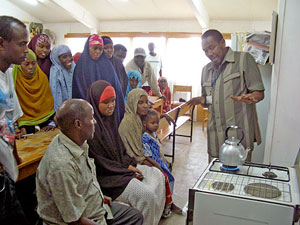
SOME BASICS: Instructor Abdullahinur Sheik Kassim of the International Organization for Migration leads a class of U.S.-bound Somalis during a three-day course on life in America, covering everything from stoves and toilets to women’s rights and gay marriage.

Apart from being a very entertaining and enlightening read, the contrast between the cultures and peoples' lives in different environments was thought provoking.

Have a read and see what you think.

Dave

KAKUMA, Kenya — They had learned how to buy bus tokens and clip coupons. Gotten hands-on training for lighting a gas stove and flushing a toilet. Taken a pop quiz on women's rights.

But for a group of U.S.-bound Somalian immigrants taking a three-day crash course on life in America recently, one topic by far stirred the most buzz: snow.

Staring at pictures of snow-covered roofs and hearing stories about waking up to find a frontyard covered in white, the Somalis (who'd rarely felt temperatures below 60 degrees) peppered the instructor with questions.

"How do I save my family from this … snow?" asked Hassan Mohammed Abrone, 41, a father of two who was already trying to embrace the American lifestyle by wearing a Statue of Liberty baseball cap and a pair of secondhand Nike Airs.

After hearing a description of coats, scarves, gloves and long underwear, another student, Lelya Yussuf, 23, asked: "How can we walk while wearing all that? Isn't it too heavy?" In an effort to explain snow to people who have never seen it, the instructor asked students to imagine how it would feel to live inside a refrigerator. But the analogy fell flat for some, because they'd never heard of such an appliance.

"This job takes a lot of patience," instructor Abdullahinur Sheik Kassim said. "You can't take anything for granted."

For the Somalis in this northern Kenya refugee camp, passing a class in America 101 is the final hurdle to boarding airplanes for new lives. As they fly toward the United States, they will learn for the first time where their new homes will be.

A speed-read through American culture, the U.S.-mandated class tries to prepare them for what they will find when they arrive. It covers everything from mini-malls and microwaves to same-sex marriage.

For most of the students, ranging in age from 4 to 65, it's a steep learning curve. They've spent much of their lives fleeing Somalia's 15-year civil war, scrambling to survive in the bush or toiling in squalid refugee camps. Most come from persecuted ethnic groups and clans, such as the Bantu or Ashraf, that were the first to lose what little property they had after the collapse of Mohamed Siad Barre's regime in 1991. Now those same injustices have made them eligible to escape to the United States.

The cultural orientation class is one of hundreds given each year in Africa by the International Organization for Migration, or IOM, one of the world's largest refugee-assistance groups, which organizes the class with funding from the U.S. State Department.

Such programs began in the 1970s for Southeast Asian refugees heading to the United States. Back then, immigrants spent months at transition camps, learning the English language and American customs before entering the country. Over the years, budget cuts have pruned the orientation program to less than a week.

"In just three days, there is not a lot that we can realistically do," said Pindie Stephen, the group's regional coordinator for the classes in Kenya. "All we can do is plant the seeds of values and concepts they will encounter later. And we try to dispel myths, because so much of what they learn is from the rumor mill."

Refugees often believe that life in the U.S. will be easy, that they will live in big homes with cars and television sets. Such descriptions come from relatives in America who sometimes exaggerate their prosperity, or from the U.S.-made TV movies occasionally shown inside refugee camps.

"I know all about America," said Amal Nuradia, 27. "I've seen the Hallmark Channel." She is among the thousands of Somalian refugees at Kakuma, most of whom fled their country more than a decade ago. More than 12,000 have resettled in the U.S. in recent years.

"What do you know about America?" Kassim asked at the beginning of a recent orientation class. Students yelled out their answers: It's a superpower. People are always in a hurry. Neighbors don't talk to each other. Dogs are treated like people. Gay people get married. All children go to school.

With only 15 hours of class, Kassim wasted no time, covering U.S. history in less than 90 seconds. George Washington was the first president. Abraham Lincoln freed the slaves. Martin Luther King Jr. marched for civil rights. Time for the next subject.

Much of the curriculum is based on feedback from recent immigrants. For example, when new immigrants complained about being bewildered by the modern conveniences of a typical American home, IOM built a fully functioning kitchen and bathroom at the back of one classroom. Long flights to the U.S. were so traumatic that a video was added about airplanes, from lavatories to airsickness bags.

Somalian Bantu, who were historically treated like slaves by other groups and lived in mud huts in the bush without water or electricity, usually know little of modern society, needing instruction on such basic tasks as flipping light switches or turning doorknobs. Other students are from more developed urban centers, such as Mogadishu, the Somalian capital, but even they have limited exposure to sights such as skyscrapers, freeways or elevators, and their children have been largely raised on the run or inside refugee camps.

Sensing the students' anxiety about snow, Kassim spent the next hour explaining U.S. weather. In their textbooks, students read about the importance of punctuality and Americans' "obsession" with cleanliness.

Of the 25 students, only one spoke English, so Kassim practiced some key English phrases.

"Po-LEESE! Po-LEESE!" the students recited in unison, practicing a 911 call.

Coming from a country without government or law, the idea that help is only a phone call away amazed Yussuf, whose parents were killed and who is traveling to the U.S. alone. "So if anyone bothers me, I just call 911 and the police come and beat them?" she asked. "Life must be very easy."

Immigrants also heard about U.S. laws. Beating your wife and children is illegal, they were told, and so is chewing khat, the leafy amphetamine-like stimulant popular in Somalia. Performing genital excision on young girls is prohibited.

"If I can't beat my wife, how will she know that I love her?" Abrone asked, seated next to his silent teenage bride.

Monogamy was equally unpopular with some men, who said their religion permitted four wives. But Kassim shut down the debate. "It doesn't matter," he told them. "In the U.S. you'll barely be able to afford one wife, anyway."

The second day of class began with an exercise in equality. Students broke into teams and were asked to identify which potential U.S. jobs — taxi driver, hairdresser or doctor, for example — were held exclusively by men and which were held by women. It was a trick question, designed to spark a discussion about gender equality.

In one group, Abdi Ahmed Mohammed, 56, a former Mogadishu shopkeeper, grabbed the worksheet and began dividing the occupations by gender.

"Wait," Yussuf complained. "Why is 'housekeeper' female?"

"It's woman's work," Mohammed snapped, checking the box for "female."

As the instructor began calling on students to defend their answers, it became clear that, at least in the U.S., the correct answer for all jobs was "both." Mohammed began discreetly erasing his worksheet, and when the instructor asked for his answer for "baby-sitter," he covered the paper with an arm and answered confidently, "Both."

The day ended with a tour of the mock kitchen and bathroom. Mohammed ran his fingers over the surface of the gas stove as if it were a shiny new Porsche. Kassim demonstrated how to use a variety of strange Western products, including toothpaste, shampoo and toilet paper.

"Why must I hide behind the curtain in the shower?" one student asked.

"It's to prevent the water from splashing," Kassim explained.

Some refugee experts worry that the classes focus too heavily on such basic household lessons.

"They can learn about flushing toilets and riding buses once they get there," said Hussain Mahmood, head of the Kakuma branch of the Office of the United Nations High Commissioner for Refugees, which also works with Somali refugees. "Instead, I think they'd be better served by a frank discussion about the discrimination and hostilities they may face as Muslims or Africans in the U.S. What's going to happen when a woman in a scarf meets some skinhead? I'd like to see more about dealing with those cultural challenges."

By the end of the second day, however, the challenges of living in the U.S. were beginning to sink in for some.

"I'm starting to worry about where I will live and who will take care of my baby when I go to work," said Fozia Ahmed Hussein Mohammed, 24 and eight months pregnant. Her boyfriend was not eligible to go with her.

"This is going to be more difficult than I thought," she said.

By the third day, Kassim was scrambling to squeeze in the final lessons. He turned to finances and budgeting. Immigrants might hope to earn $1,000 a month, he told them, but rent for a two-bedroom apartment averages $800, depending upon the area. "One income will not be enough," he said.

New arrivals get a 30-day assistance package, including help finding a house or apartment, but after that they are expected to find employment. U.S. government relief programs, such as food stamps and welfare, are also available to immigrants.

Kassim concluded with a lesson that left many students in disbelief. He showed them a large chart displaying immigrants' typical mood swings, first soaring during a "honeymoon" phase, then plummeting during a "depression" and finally settling at a "recovery."

"At first you will feel as if you've gone to paradise," Kassim said. "Everything is so easy." But research has shown that later many will experience sadness, loneliness, culture shock and pangs of guilt over friends and family left behind in Africa.

"It's called stress," he told them. "You can't sleep. You watch TV all the time. Some people even kill themselves." A few students stiffened in their chairs. A couple laughed nervously. It was incomprehensible that they would survive years of hunger and homelessness in Somalia only to commit suicide in one of the richest countries in the world.

"How could we feel depressed there?" Abdi Ahmed Mohammed asked. "After the life we are living, any other life will be better." Asked for a show of hands of how many believed they might experience stress or sadness, not a single hand went up.

"We do what we can to warn them," Kassim said after conducting a brief graduation ceremony. "I hope they are ready."

Outside, graduates clutched their cultural orientation "diplomas," unable to hide their growing excitement. Some would board airplanes in a matter of days.

Sofia Sharif, 21, was 6 when her village was attacked. Her father was killed; her mother and five siblings disappeared into the bush. Today she is alone in the world, except for a distant older cousin who kept Sharif out of school and forced her to keep house and take care of the cousin's children.

"If my parents had lived, I might have had the chance to go to school," Sharif said. "But so what? I'm 21. I'm single. And now I'm going to America."