Friday, September 08, 2006

Japan's thought police

BIG BROTHER ALERT
The Rise of Japan's Thought Police

By Steven Clemons
Sunday, August 27, 2006;


Anywhere else, it might have played out as just another low-stakes battle between policy wonks. But in Japan, a country struggling to find a brand of nationalism that it can embrace, a recent war of words between a flamboyant newspaper editorialist and an editor at a premier foreign-policy think tank was something far more alarming: the latest assault in a campaign of right-wing intimidation of public figures that is squelching free speech and threatening to roll back civil society.

On Aug. 12, Yoshihisa Komori -- a Washington-based editorialist for the ultra-conservative Sankei Shimbun newspaper -- attacked an article by Masaru Tamamoto, the editor of Commentary, an online journal run by the Japan Institute of International Affairs. The article expressed concern about the emergence of Japan's strident new "hawkish nationalism," exemplified by anti-China fear-mongering and official visits to a shrine honoring Japan's war dead. Komori branded the piece "anti-Japanese," and assailed the mainstream author as an "extreme leftist intellectual."

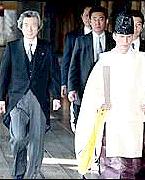
But he didn't stop there. Komori demanded that the institute's president, Yukio Satoh, apologize for using taxpayer money to support a writer who dared to question Prime Minister Junichiro Koizumi's annual visits to the Yasukuni Shrine, in defiance of Chinese protests that it honors war criminals from World War II.

Remarkably, Satoh complied. Within 24 hours, he had shut down Commentary and withdrawn all of the past content on the site -- including his own statement that it should be a place for candid discourse on Japan's foreign-policy and national-identity challenges. Satoh also sent a letter last week to the Sankei editorial board asking for forgiveness and promising a complete overhaul of Commentary's editorial management.

The capitulation was breathtaking. But in the political atmosphere that has overtaken Japan, it's not surprising. Emboldened by the recent rise in nationalism, an increasingly militant group of extreme right-wing activists who yearn for a return to 1930s-style militarism, emperor-worship and "thought control" have begun to move into more mainstream circles -- and to attack those who don't see things their way.

Just last week, one of those extremists burned down the parental home of onetime prime ministerial candidate Koichi Kato, who had criticized Koizumi's decision to visit Yasukuni this year. Several years ago, the home of Fuji Xerox chief executive and Chairman Yotaro "Tony" Kobayashi was targeted by handmade firebombs after he, too, voiced the opinion that Koizumi should stop visiting Yasukuni. The bombs were dismantled, but Kobayashi continued to receive death threats. The pressure had its effect. The large business federation that he helps lead has withdrawn its criticism of Koizumi's hawkishness toward China and his visits to Yasukuni, and Kobayashi now travels with bodyguards.

In 2003, then-Japanese Deputy Foreign Minister Hitoshi Tanaka discovered a time bomb in his home. He was targeted for allegedly being soft on North Korea. Afterward, conservative Tokyo Gov. Shintaro Ishihara contended in a speech that Tanaka "had it coming."

Another instance of free-thinking-meets-intimidation involved Sumiko Iwao, an internationally respected professor emeritus at Keio University. Right-wing activists threatened her last February after she published an article suggesting that much of Japan is ready to endorse female succession in the imperial line; she issued a retraction and is now reportedly lying low.

Such extremism raises disturbing echoes of the past. In May 1932, Japanese Prime Minister Tsuyoshi Inukai was assassinated by a group of right-wing activists who opposed his recognition of Chinese sovereignty over Manchuria and his staunch defense of parliamentary democracy. In the post-World War II era, right-wing fanatics have largely lurked in the shadows, but have occasionally threatened those who veer too close to or speak too openly about sensitive topics concerning Japan's national identity, war responsibility or imperial system.

What's alarming and significant about today's intimidation by the right is that it's working -- and that it has found some mutualism in the media. Sankei's Komori has no direct connection to those guilty of the most recent acts, but he's not unaware that his words frequently animate them -- and that their actions in turn lend fear-fueled power to his pronouncements, helping them silence debate. What's worse, neither Japan's current prime minister nor Shinzo Abe, the man likely to succeed him in next month's elections, has said anything to denounce those trying to stifle the free speech of Japan's leading moderates.

There are many more cases of intimidation. I have spoken to dozens of Japan's top academics, journalists and government civil servants in the past few days; many of them pleaded with me not to disclose this or that incident because they feared violence and harassment from the right. One top political commentator in Japan wrote to me: "I know the right-wingers are monitoring what I write and waiting to give me further trouble. I simply don't want to waste my time nor energy for these people."

Japan needs nationalism. But it needs a healthy nationalism -- not the hawkish, strident variety that is lately forcing many of the country's best lights to dim their views.


steve@thewashingtonnote.com


Steven Clemons is director of the American Strategy Program at the New America Foundation and co-founder of the Japan Policy Research Institute.

Sunday, August 20, 2006

Shrinking-Vacation Syndrome

By TIMOTHY EGAN

SEATTLE, Aug. 19 — In August, when much of the world is hard at work trying to do nothing, Jeff Hopkins and his wife, Denise, usually take a week to chase fish in Olympic National Park — a ferry ride and two tanks of gas from here with a boat in tow. But this year, their summer vacation is dead, a victim of $3-a-gallon gas and job uncertainty.

“This is our vacation,” said Mr. Hopkins, loading up his drift boat for an evening of fishing in the city just after getting off work at the Boeing plant, where he has been employed for 15 years.

Even before toothpaste could clog an airport security line and a full tank of gas was considered an indulgence, Americans had begun to sour on the traditional summer vacation. But this summer, a number of surveys show that American workers, who already take fewer vacations than people in nearly all industrial nations, have pruned back their leisure days even more.

The Conference Board, a private research group, found that at the start of the summer, 40 percent of consumers had no plans to take a vacation over the next six months — the lowest percentage recorded by the group in 28 years. A survey by the Gallup Organization in May based on telephone interviews with a national sample of 1,003 adults found that 43 percent of respondents had no summer vacation plans.

About 25 percent of American workers in the private sector do not get any paid vacation time, the Bureau of Labor Statistics reports. Another 33 percent will take only a seven-day vacation, including a weekend.

“The idea of somebody going away for two weeks is really becoming a thing of the past,” said Mike Pina, a spokesman for AAA, which has nearly 50 million members in North America. “It’s kind of sad, really, that people can’t seem to leave their jobs anymore.”

Shrinking-vacation syndrome has gotten so bad that at least one major American company, the accounting firm PricewaterhouseCoopers, has taken to shutting down its entire national operation twice a year to ensure that people stop working — for about 10 days over Christmas, and 5 days or so around the Fourth of July.

“We aren’t doing this to push people out the door,” said Barbara Kraft, a partner at the firm in the human resources office. “But we wanted to create an environment where people could walk away and not worry about missing a meeting, a conference call or 300 e-mails.”

The company tracks vacation time so that when employees fall behind, they are reminded through an electronic nag that they should be getting out of the office more. And posters evoking lazy days away from work were put up in the New York offices. Hint. Hint.

The heightened pace of American life, aided by ever-chattering electronic pocket companions, gets much of the blame for the inability of many people to take extended periods of forced sloth.

“I thought I would take at least five days off and go somewhere, but I couldn’t find the time,” said Tina Yang, who teaches first grade at Fruit Ridge Elementary School in Sacramento. She has the summers off, but her days are filled with catch-up work, conferences and projects, she said.

“I realize I just go to work and then home, work and then home — it’s no way to live,” Ms. Yang said.

The Travel Industry Association, the largest trade group representing the industry, found that the average American expects his or her longest summer trip to last only six nights. And it takes three days just to begin to unwind, experts say.

Company leaders at PricewaterhouseCoopers said they started their nationwide shutdown because people were not getting their batteries recharged. Now that the entire work force of about 29,000 takes a vacation, company officials say they are seeing positive results.

“It has taught our people what it is like to have unencumbered time,” Ms. Kraft said.

Saturday, August 19, 2006

Health, plates, and cups

NEW YORK - Want to lose weight? Try eating off smaller plates. A new study shows that using smaller bowls and spoons may curb the amount of food eaten.

"People could try using the size of their bowls and possibly serving spoons to help them better control how much they consume," write researchers in the American Journal of Preventive Medicine.

"Those interested in losing weight should use smaller bowls and spoons, while those needing to gain weight — such as the undernourished or aged — could be encouraged to use larger ones," add Dr. Brian Wansink, of Cornell University, and colleagues.

In a prior study, researchers found that teenagers poured 77 percent less juice into tall narrow glasses than they did into short wide glasses. Similarly, in another study, Philadelphia bartenders were found to pour less liquor into "highball" glasses than they did into tumblers. These studies suggest that individuals may adjust their serving portions depending on the size of their bowls or spoons.

To investigate, Wansink and his team conducted a study of 85 nutrition experts, including faculty, staff, and graduate students, from a large midwestern university, who attended an ice cream social. They were randomly given a 17 ounce or 34 ounce bowl along with a 2 ounce or 3 ounce ice cream scoop and allowed to serve themselves ice cream.

Afterwards, their ice cream was weighed while they completed a short survey about how much ice cream they thought they had served themselves and how the size of their bowl and spoon differed from what they normally used.

Study participants who received the larger bowls unknowingly served themselves 31 percent more ice cream than did those with smaller bowls. Ice cream servings also increased by 14.5 percent among those with larger serving spoons, regardless of the size of the bowl. And nearly all of the adults (82 of 85) ate all of their ice cream.

Altogether, those with large bowls and large serving spoons served themselves — and ate —nearly 57 percent more ice cream than those with smaller bowls and spoons, the team reports.

"What is critical to note, however, is that people — even these nutrition experts — are generally unaware of having served themselves more," write the authors.

"The fact that even they end up being tripped up by these cues just helps to show how ubiquitous and how subversive these illusions can be," Wansink said in a statement.

Based on the findings, "obese patients may want to use smaller bowls and spoons at home to reduce over-consumption," according to Wansink and his colleagues.

Among undernourished individuals, on the other hand, "larger bowls and spoons would encourage more food intake than the smaller bowls and spoons that are often provided," they conclude.

Wednesday, August 16, 2006

War Responsibility

Delving into the past (1) / Who should bear the most blame for the Showa War?

The Yomiuri Shimbun


This is just the first of a long series or articles dealing with exactly what happened and who was responsible. As issues of visits to the Yasukuni Shrine have been controversial and will likely continue to be so for some time, this struck me as being timely and mature. At the time of writing the articles have so far totalled 22... a very long series.

Dave


Why did Japan engineer the Manchurian Incident and then launch the Sino-Japanese War? Why did the nation attack the United States and recklessly continue to fight when prospects for victory were fading fast? Wasn't it possible to avoid the atomic bombings of Hiroshima and Nagasaki by the United States?

In an attempt to find answers to these questions, The Yomiuri Shimbun's War Responsibility Verification Committee over the past year has verified a series of battles in the "Showa War."

Which political and military leaders should take the blame at each critical phase of these wars? We now present our conclusions.

The starting point of the Showa War was the Manchurian Incident that took place in September 1931. Who should be blamed for having caused the incident? The main instigators of the incident were Kanji Ishihara and Seishiro Itagaki, staff officers of the Kwantung Army, a unit of the Imperial Japanese Army.

Determined to conspire together to grab power and lead the country, they became the masterminds of the act of aggression into Manchuria (currently part of northeastern China) and literally dragged the nation into a series of wars.

At the core of Lt. Col. Ishihara's militarist thinking was the pursuit of the "Final World War Theory" to determine the No. 1 country of the world in a war between Japan and the United States, which he considered the greatest nations of the Eastern and Western civilizations, respectively.

In January 1928, at a meeting of the Mokuyo-kai (Thursday Society) group of elite officers who graduated from the Imperial Japanese Army's War College, Ishihara said, "The nation could stand being in a state of war for even 20 years or 30 years if we have footholds all over China and fully use them."

In June of that year, Daisaku Komoto, the predecessor of Itagaki, assassinated Zhang Zuolin, a Chinese warlord who had a strong influence in Manchuria, by blowing up the train in which he was traveling. This incident would become a model for the Manchurian Incident.

The Manchurian Incident took place as members of the Kwantung Army blew up a section of South Manchuria Railway lines in Liutiaogou (Lake Liutiao), outside Mukden (currently Shenyang). The army then took control of Mukden in a single day. The temporary mayor's post of Mukden was taken up by Kenji Dohihara, then chief of the Mukden Special Service Agency.

The Kwantung Army began advancing into Jilin Province beyond its original garrison areas. Shigeru Honjo, then commander of the Kwantung Army, initially opposed sending troops to Jilin. But he eventually yielded to Itagaki's persistence and decided to give the go-ahead to the deployment.

Senjuro Hayashi, commander of the Japanese Army in Korea, also decided to dispatch his troops to Manchuria without an order. He followed advice from staff officers of the Japanese Army in Korea, who had ties with Ishihara and Itagaki.

Kingoro Hashimoto, chief of the Russia group of the Army General Staff's 2nd Bureau, had close contacts with them.

Hashimoto formed the Sakura-kai (Cherry Society) group that comprised young reformist officers, and used the group as a foothold to lead two failed coup attempts called the "March Incident" and the "October Incident." The March Incident was aimed at installing War Minister Kazushige Ugaki as prime minister. Others involved in the incident included Kuniaki Koiso, chief of the ministry's Military Affairs Bureau.

The October Incident was linked to the Manchurian Incident, although it was poorly planned. However, it would be the forerunner for a series of coups and terrorist acts, such as the May 15 Incident of 1932 and Feb. 26 Incident of 1936.

Before the Manchurian Incident, War Minister Jiro Minami strongly advocated to take hard line stance on Manchuria and Inner Mongolia. Without complaint, Prime Minister Reijiro Wakatsuki readily approved the dispatch of troops from the Japanese Army in Korea to Manchuria at its own discretion after being told about it by Minami.

The helplessness of politicians from being able to prevent military officers stationed outside the country from spinning out of control surfaced for the first time at this point.

On March 1, 1932, less than six months after the Manchurian Incident, the establishment of Manchukuo as a country was declared. Dohihara had Aixinjueluo Puyi, the last emperor of the Qing dynasty, serve as the sovereign head of Manchukuo under the title of regent and later emperor.

Meanwhile, the battlefield temporarily spread to Shanghai. This development, called the First Shanghai Incident, was plotted by Ryukichi Tanaka, an assistant army attache at the Japanese Legation in Shanghai. Tanaka had been instructed by Itagaki to carry out such a plot in Shanghai in an attempt to divert the world powers' attention from the establishment of Japan's puppet state in Manchuria.

Shortly after this, Prime Minister Tsuyoshi Inukai was assassinated in the May 15 Incident. The cabinet of Makoto Saito, Inukai's successor, approved the establishment of Manchukuo. Prior to this, the House of Representatives unanimously passed a resolution to approve Manchukuo as a nation. At a plenary session of the lower house, Foreign Minister Yasuo Uchida said the nation would not hand over its rights and interests in Manchuria even if Japan's territory was turned into "scorched earth." Uchida responded to an interpellation by Tsutomu Mori, a member of the Rikkenseiyukai party, also known as Seiyukai. Mori symbolized the politicians who were vocal in calling for the maintenance of rights and interests in Manchuria and Inner Mongolia.

A report by the Lytton Commission, an investigation team led by Victor Alexander George Robert (V.A.G.R.) Bulwer-Lytton appointed by the League of Nations on Japan's advance in Manchuria, was submitted to Japan in October 1932. War Minister Sadao Araki harshly criticized the report and called for the nation to withdraw from the League of Nations. Araki, who served as war minister in the cabinets of Inukai and Saito, thus openly endorsed the actions of the Kwantung Army.

The Lytton Report did not condemn Japan in a one-sided manner. Indeed, the report included a proposal to establish a provincewide, autonomous government in Manchuria. But when a recommendation statement based on the Lytton Report was adopted at the General Assembly of the League of Nations, only Japan opposed it. Yosuke Matsuoka, head of the Japanese delegation, then walked out of the meeting, signifying Japan's withdrawal from the league.


Those mainly responsible

-- Kanji Ishihara, staff officer of the Kwantung Army

-- Seishiro Itagaki, staff officer of the Kwantung Army

-- Kenji Dohihara, chief of the Mukden Special Service Agency

-- Kingoro Hashimoto, chief of the Russia group of the Army General Staff's 2nd Bureau

>>Major events relating to Showa War<<

June 4, 1928: Assassination of Zhang Zuolin

Sept. 18, 1931: Outbreak of Manchurian Incident

March 1, 1932: Declaration of establishment of Manchukuo

May 15, 1932: May 15 Incident

March 27, 1933: Japan withdraws from League of Nations

Feb. 26, 1936: Feb. 26 Incident

Dec. 25, 1936: Conclusion of anticommunism treaty with Germany

July 7, 1937: Outbreak of Sino-Japanese War

Sept. 1, 1939: Outbreak of World War II

Sept. 27, 1940: Conclusion of Tripartite Treaty with Germany and Italy

April 13, 1941: Signing of Japanese-Soviet Neutrality Treaty

July 28, 1941: Advancement into southern French Indochina

Oct. 18, 1941: Establishment of cabinet of Hideki Tojo

Dec. 1, 1941: Decision to wage war against United States, Britain and Netherlands made at Imperial Council meeting

Dec. 8, 1941: Outbreak of war against the United States (Dec. 7 U.S. time)

June 7, 1942: Defeat at Battle of Midway

June 19, 1944: Defeat at Battle of Marianas

July 7, 1944: Mass suicidal attack at Saipan

July 18, 1944: Resignation en masse of Tojo Cabinet

March 10, 1945: Major Tokyo air raids

April 1, 1945: U.S. forces land on Okinawa

May 7, 1945: Germany unconditionally surrenders

July 27, 1945: Allied Powers issue Potsdam Declaration

Aug. 6, 1945: Atomic bomb dropped on Hiroshima

Aug. 8, 1945: Soviet Union declares war against Japan

Aug. 9, 1945: Atomic bomb dropped on Nagasaki

Aug. 14, 1945: Imperial Council accepts Potsdam Declaration

Aug. 15, 1945: Emperor's surrender rescript broadcast

Sept. 2, 1945: Instruments of Surrender signed aboard USS Missouri on Tokyo Bay

(Aug. 13, 2006)

Wednesday, August 09, 2006

Encountering Steven Green

By Andrew Tilghman
Sunday, July 30, 2006; B01


" I came over here because I wanted to kill people."

Over a mess-tent dinner of turkey cutlets, the bony-faced 21-year-old private from West Texas looked right at me as he talked about killing Iraqis with casual indifference. It was February, and we were at his small patrol base about 20 miles south of Baghdad. "The truth is, it wasn't all I thought it was cracked up to be. I mean, I thought killing somebody would be this life-changing experience. And then I did it, and I was like, 'All right, whatever.' "

He shrugged.

"I shot a guy who wouldn't stop when we were out at a traffic checkpoint and it was like nothing," he went on. "Over here, killing people is like squashing an ant. I mean, you kill somebody and it's like 'All right, let's go get some pizza.' "

At the time, the soldier's matter-of-fact manner struck me chiefly as a rare example of honesty. I was on a nine-month assignment as an embedded reporter in Iraq, spending much of my time with grunts like him -- mostly young (and immature) small-town kids who sign up for a job as killers, lured by some gut-level desire for excitement and adventure. This was not the first group I had run into that was full of young men who shared a dark sense of humor and were clearly desensitized to death. I thought this soldier was just one of the exceptions who wasn't afraid to say what he really thought, a frank and reflective kid, a sort of Holden Caulfield in a war zone.

But the private was Steven D. Green.

The next time I saw him, in a front-page newspaper photograph five months later, he was standing outside a federal courthouse in North Carolina, where he had pled not guilty to charges of premeditated rape and murder. The brutal killing of a 14-year-old Iraqi girl and her family in Mahmudiyah that he was accused of had taken place just three weeks after we talked.

When I met Green, I knew nothing about his background -- his troubled youth and family life, his apparent problems with drugs and alcohol, his petty criminal record. I just saw and heard a blunt-talking kid. Now that I know the charges against Green, his words take on an utterly different context for me. But when I met him then, his comments didn't seem nearly as chilling as they do now.

Maybe, in part, that's because we were talking in Mahmudiyah. If there's one place where a soldier might succumb to what the military calls "combat stress," it's this town where Green's unit was posted on the edge of the so-called Triangle of Death, for the last three years a bloody center of the Sunni-led insurgency. Mahmudiyah is a deadly patch of earth that inspires such fear, foreboding and uneasiness that my most prominent memory of the three weeks I spent there was the unrelenting knot it caused in my stomach.

I was nervous even before I arrived. Although Mahmudiyah is only a 15-minute drive from the heavily fortified Green Zone in Baghdad, I was taken there by helicopter. Military officials didn't want to risk my riding in a truck that might be hit by a roadside bomb. I'd chosen to go to Mahmudiyah because I wanted to be on the front lines of the war and among the troops fighting it.

When I arrived in February, Green's battalion -- the 101st Airborne Division's 502nd Infantry Regiment -- was losing an average of about one soldier per week. Whenever I asked how many of the nearly 1,000 troops posted there had been killed so far, most soldiers would just frown and say they'd lost count.

Danger was everywhere. Inside the American base camps, mortar shells fell almost daily. In the towns where U.S. forces patrolled, car bombs were a constant threat. On the rural roads, the troops kept watch for massive artillery rounds hidden under piles of trash that could shred the engine block of an armored Humvee and separate a driver's limbs from his torso.

About a month before I arrived at Green's base -- an abandoned potato-packing plant lined with 20-foot concrete walls -- the soldiers there fought off a full-blown assault that rallied dozens of insurgents in a show of force almost unheard of for a shadowy enemy that typically avoids face-to-face combat. It took more than an hour to quell the attack of gunfire and rocket-propelled grenades coming from all sides of the camp.

Morale took another nosedive soon after, when the hastily rigged electrical wiring system caught fire and burned down the Americans' living quarters. The soldiers watched as the early-morning blaze destroyed all reminders of home: the family photographs, the iPods and the video games that provide brief escapes from combat. When I got there a week later, a chow-hall storage room, packed with radios and satellite maps, was serving as the base command center. The sergeants were still passing out toothbrushes and clean socks to the young troops who had lost everything.

The company commander in charge of Green's unit told me that the situation was so stressful that he himself had "almost had a nervous breakdown" and had been sent to a hotel-style compound in Baghdad for three days of "freedom rest" before resuming his command.

And yet despite the horrific conditions in which they were daily being tested, I found extraordinary camaraderie among the soldiers in Mahmudiyah. They were among the friendliest troops I met in Iraq.

Green was one of several soldiers I sat down with in the chow hall one night not long after my arrival. We talked over dinner served on cardboard trays. I asked them how it was going out there, and to tell me about some of their most harrowing moments. When they began talking about the December death of Sgt. Kenith Casica, my interview zeroed in on Green.

He described how after an attack on their traffic checkpoint, he and several others pushed one wounded man into the back seat of a Humvee and put Casica, who had a bullet wound in his throat, on the truck's hood. Green flung himself across Casica to keep the dying soldier from falling off as they sped back to the base.

"We were going, like, 55 miles an hour and I was hanging on to him. I was like, 'Sgt. Casica, Sgt. Casica.' He just moved his eyes a little bit," Green related with a breezy candor. "I was just laying on top of him, listening to him breathing, telling him he's okay. I was rubbing his chest. I was looking at the tattoo on his arm. He had his little girl's name tattooed on his arm.

"I was just talking to him. Listening to his heartbeat. It was weird -- I drooled on him a little bit and I was, like, wiping it off. It's weird that I was worried about stupid [expletive] like that.

"Then I heard him stop breathing," Green said. "We got back and everyone was like, 'Oh [expletive], get him off the truck.' But I knew he was dead. You could look in his eyes and there wasn't nothing in his eyes. I knew what was going on there."

He paused and looked away. "He was the nicest man I ever met," he said. "I never saw him yell at anybody. That was the worst time, that was my worst time since I've been in Iraq."

Green had been in country only four months at that point, a volunteer in a war he now saw as pointless.

"I gotta be here for a year and there ain't [expletive] I can do about it," he said. "I just want to go home alive. I don't give a [expletive] about the whole Iraq thing. I don't care.

"See, this war is different from all the ones that our fathers and grandfathers fought. Those wars were for something. This war is for nothing."

A couple of days later, I ran into Green again, and he invited me to join him and another soldier in a visit to the makeshift tearoom run by the Iraqi soldiers who share the base with the American troops. It was after dusk, and the three of us walked across a pitch-black landing zone and into a small plywood-lined room where a couple of dozen barefoot Iraqi soldiers were sitting around watching a local news channel.

"Hey, shlonek ," Green said, offering a casual Arabic greeting with a smile and a sweeping wave as he stepped up to the bar. He handed over a U.S. dollar in exchange for three Styrofoam cups of syrupy brown tea.

Green knew a few words of Arabic, and along with bits of broken English, some hand gestures and smiles, he joked around with the Iraqis as he sipped their tea. Most U.S. soldiers didn't hang out on this side of the base with the Iraqis.

I asked Green whether he went there a lot. He did, he said, because he liked to get away from the Americans "who are always telling me what to do."

"These guys are cool," he said, referring to the Iraqis.

"But," he added with a shrug, "I wouldn't really care if all these guys got waxed."

As we talked, Green complained about his frustration with the Army brass that urged young soldiers to exercise caution even in the most terrifying and life-threatening circumstances.

"We're out here getting attacked all the time and we're in trouble when somebody accidentally gets shot?" he said, referring to infantrymen like himself throughout Iraq. "We're pawns for the [expletive] politicians, for people that don't give a [expletive] about us and don't know anything about what it's like to be out here on the line."

The soldiers who fought alongside Green lived in conditions of near-constant violence -- violence committed by them, and against them.

Even in my brief stay there, I repeatedly encountered terrifying attacks. One night, about a mile from Green's base, a roadside bomb exploded alongside the vehicle I was riding in, unleashing a deafening crack and a ball of fire. In most places in Iraq, soldiers would have stopped to investigate. In the Triangle of Death, however, we just plowed on through the cloud of smoke and shower of sparks, fearing an ambush if we stopped. Fortunately, the bomb was relatively small, its detonation poorly timed, and the soldiers all laughed about it moments later. "Dude, that was [expletive] awesome," the driver said after making sure no one was hurt.

A few days later, I was standing outside chatting with an officer about the long-term legacy of the Vietnam War when a rocket came whistling down and struck the base's south wall. A couple of days after that, a mortar round blew up a tent about 20 feet from the visitors' tent that I called home.

My experience, however, was nothing compared with that of Green and the other young men of his Bravo company who spent months in the Triangle of Death.

In the end, I never included Green's comments in any of the handful of stories I wrote from Mahmudiyah for Stars and Stripes. When he said he was inured to death and killing, it seemed to me -- in that place and at that time -- a reasonable thing to say. While in Iraq, I also saw people bleed and die. And there was something unspeakably underwhelming about it. It's not a Hollywood action movie -- there are no rapid edits, no adrenaline-pumping soundtracks, no logical narratives that help make sense of it. Bits of lead fly through the air, put holes in people and their bodily fluids leak out and they die. Those who knew them mourn and move on.

But no level of combat stress is an excuse for the kind of brutal acts Green allegedly committed. I suppose I will always look back on our conversations in Mahmudiyah and wonder: Just what did he mean?

andrewtilghman1@yahoo.com

Andrew Tilghman was a correspondent in Iraq for the military newspaper Stars and Stripes. He lives in Houston.