Sunday, September 24, 2006

Guys' fantasy dates

Dating the woman of your dreams
By Dan Bova


This is a little bizarre, but certainly interesting reading. And this is only half the story...
Dave


When it comes to fantasy women, guys aren’t the most original. For generations, most men have imagined smokin’ hot bikini models in magazines drooling right back at us or a pretty masseuse who offers up backrubs 24/7. While most guys accept that these are unattainable fantasies, some are able to make them realities. We asked the latter group of lucky fellas if dating these dream lovers lived up to their great expectations. Read on to hear what it’s really and truly like to date one of these women.

Dream date #1: Flight attendant
“I met Liv on a flight from New York to Atlanta. I stood around the jump seat area under the pretense of stretching my legs (flight attendants get totally hot for guys who know how to combat deep vein thrombosis, right?) and asked her about a book she was reading. I thought that it would be fantastic to brag that I was dating a flight attendant. It has a sexy, glamorous quality, plus I figured there would be tons of free trips and unexpected getaways to exotic locales. Every guy I ever told, ‘I’m dating a flight attendant’ got a faraway look in his eye and just nodded his head to silently say, ‘Good man, good man.’ The bragging rights totally exceeded my expectations, but the getaways turned out to be kind of a pain. You get to fly for free basically, but you never know when or if you can get back from where you came. Another downside was that she was flying the B-list routes to none-too-scenic small towns all over the interior of the country and dealing with irate passengers all day long, so she wasn’t usually in the best of moods when we got to spend time together. But still, she was gorgeous. And in the time we dated, I never got more high-fives from other dudes in my life.”
- Wayne, 28 Atlanta, GA

Dream date #2: Massage therapist
"The first time I went out with this woman, she told me she was a massage therapist and I admit I thought it was hot. I figured that she’d be in shape, comfortable with her body, somewhat health-conscious and down-to-earth—and would be giving me killer massages all of the time. I got the first parts right, but she came home physically tired, and I ended up massaging her more often than the other way around. I guess if you’re dating a dentist, the last thing she wants to do at the end of the day is help you floss. There’s some old Seinfeld episode about dating a massage therapist, and I heard about it all the time from my friends. I still haven’t seen it, but the message was kind of the same—you aren’t going to get a lot of free massages. The nights where she did surprise me with her magic hands—omigod, it was beyond awesome.”
- Edgar, 35, Tampa, FL

Dream date #3: Bartender
“I spotted Jessica at my local bar in downtown New York. I thought dating a bartender would mean a lot of late nights at the bar getting free drinks, leaving a sleeping woman in my bed when I left for work and lots of parties with her bar friends at 3 a.m. And that’s pretty much what it was like. She took me to all of these after-hours parties and had all of these great stories about crazy customers getting in fights or passing out while they were in the middle of hitting on her. It was wild. It was like living a rock-star life. Free drinks and sex at 4 o’clock in the morning... it was pretty great, actually.”
- Hugh, 30, New York City, NY

Dream date #4: Model
“It’s easy to think that models are stuck-up, but my girlfriend is nothing like that. She’s cool and down-to-earth and doesn’t fit any of those stereotypes. Her job hasn’t put any strain on our relationship at all. I mean, you have to understand exactly what being a model entails, which is your girlfriend doing photo shoots with tons of different photographers and getting all sexy in front of the camera. If you’re the jealous type, don’t date a model. You have to trust that even though all of these guys are hitting on her at shoots or in bars, she wouldn’t cheat on you. You can’t get jealous because people are falling over themselves for her, and you can’t get cocky either because you’re dating a gorgeous woman. Honestly, beautiful as she is, the best part of our relationship is that we make each other laugh and are best friends.”
- Andrew, 23, Cleveland, OH

Dream date #5: Chef
“When I met Dee, she was just finishing up culinary school. It was great because I got to eat her homework! Now that she’s a professional chef and on her feet 15 hours a day, I feel bad having her cook for me, but I couldn’t keep her out of the kitchen if I tried. She makes the most insanely delicious food I’ve ever had in my life. Like she can make mac ‘n’ cheese that’ll blow your socks off! But she also always surprises me by making super-fancy dishes like duck just because it looked good at the market that day. She puts so much love into her dishes, you feel like you’re being taken care of. It’s really sweet. The only problem is that I’ve put on about 10 pounds since we’ve been together!”
- John, 38, Los Angeles, CA

Dream date #6: The boss
“My boss and I used to innocently flirt a lot at after work get-togethers. The flirting kept escalating, and one night, we wound up slipping out the back door and hooking up at her apartment. The first time I woke up next to her, I kind of freaked. I was like, ‘I’d better go get coffee and the paper and be Super-Guy or else she’ll fire me!’ It took a couple of dates before I could shake the ‘She’s your boss!’ voice screaming in my head. It was very nerve-wracking, always wondering if our co-workers had figured it out. I became paranoid. I’d be thinking, ‘Why did so-and-so ask me where I went this weekend? Did someone see us together?!’ And I was in this weird in-between world where I’d hear my co-workers bitch about their workloads at lunch, and later, hear her bitch about how some of my co-workers were slackers. But there were some pretty cool perks, though. Besides getting to see and work with someone I loved every day, she told me when it was a good time to ask for a raise!”
- Joe, 27, Stamford, CT

Dream date #7: Sex writer
“When I met Julie and found out she was a sex writer, of course I thought she would be wild in bed! And over the years, that has turned out to be pretty true. It’s exciting to be surprised by her creativity—I never know what she’ll do next. Sometimes she opens the closet and pulls out costumes, sometimes she brings in some interesting food items from the kitchen. There is never a dull moment. Needless to say, I love it when she is working on a new story or book! Being with a sex writer is all I dreamed it would be—and more.”
- Jay, 41, Glendale, CA

Tuesday, September 19, 2006

first female space tourist

interview with Anousheh Ansari
By Sara Goudarzi

An American-Iranian who fled Iran's Islamic revolution two decades ago fulfilled a childhood dream yesterday when she became the first female space tourist. This interview was recorded on September 15.


United States entrepreneur Anousheh Ansari has been training for six months to get away from it all. Unlike most tourists, she won't be sporting a camera around her neck, and come Monday she won't need a boarding pass to get on her flight.

That's because Ansari is no ordinary sightseer. In just three days she will escape the bounds of Earth to float around in the International Space Station (ISS) for 10 days. Iranian-American Ansari, the first female space tourist, will hitch a ride to the ISS aboard the Soyuz TMA-9 capsule along with Russian cosmonaut Mikhail Tyurin and U.S. astronaut Miguel Lopez-Alegria.

Originally, Japanese businessman Daisuke Enomoto was supposed to be the world's fourth space tourist under a deal arranged by the Virginia-based space tourism firm Space Adventures with the Russian Federal Space Agency. But Enomoto was disqualified late last month from flying due to a health concern, allowing Ansari to become a primary crewmember.

Ansari has been in quarantine since September 2 in Baikonur, Kazakhstan and has been keeping a blog to share her experience with those dreaming of spacelight, an effort Ansari wishes to continue as an outreach project upon her return.

In a telephone interview with SPACE.com, Ansari discussed the hardest part of her training, the most anticipated part of her trip, and why she takes offense to the term "space tourist."

--------------------------------------------------------------------------------

SPACE.com: With only a few days before launch, what is there still left to do?

Anousheh Ansari: I think we pretty much completed all of our training. There are just some final procedural things that we are reviewing. There are also some ceremonial things that we will be doing in the next few days such as press conferences and meetings. We just completed our final fit check today so that was I guess one of most important steps before the launch, which was conducted successfully.

SPACE.com: How do your husband and family feel about your trip?

AA: As you can imagine, they're pretty excited. They know how long I have been waiting for this day and how happy I am that it's finally here. I know they're happy for me and at the same time I am sure that they're a bit apprehensive and a little nervous about the whole thing. I especially know my mom is really nervous. They're cheering each other up, trying to stay positive, focusing on the good things, and all praying for my safe return.

SPACE.com: What's it been like being far from them during your 6-month training?

AA: It's been the hardest part of being in training. We're a close family; we spend a lot of time together. Not being with them, especially not being with my husband has been the most difficult part of the training for me.

SPACE.com: Have you been able to visit each other at all?

AA: Yes, we've had several short visits. During my [training] time, he came to Star City a few times and we met for several weekends in Europe, which meant a shorter flight for both of us. But still, it's not the same because ever since we got married over 15 years ago we've spent almost 24 hours [of each day] together because we work together so it's been very difficult. We've never been apart for such a long time.

SPACE.com: And you will never be as far distance wise as you will be in a few days.

AA: That's true too!

SPACE.com: What projects did you have to give up to go on this trip?

AA: There were a couple of things that I was negotiating and working on. One of them had to do with installing a telescope on the ISS, which was a very involved program. I was trying to find out some of the activities that different space agencies were initiating to see if I could partner with them to bring a private or commercial aspect to it. Not to use it commercially but to use it for educational purposes for amateur astronomers and other people interested in astronomy.

Unfortunately, that's a very involved program that would have taken at least a year or two to get approved and get the potential documents done and the equipment certified. So I knew for sure that wasn't going to happen on my flight. But it's something that I am going to continue pursuing and it doesn't have to be coinciding with my spaceflight.

SPACE.com: How did you find out that Diasuke Enomoto wouldn't be flying? How did it feel to no longer be the back up?

AA: I was actually going back to my room after finishing my day of training and I received a call from "Space Adventures" telling me that I've been moved up to become part of the primary crew.

First I couldn't believe it. I thought they were joking with me and then as I started believing them I was in complete shock and total excitement and you know, I would've screamed if I wasn't embarrassed of the people around me.

SPACE.com: Do you consider yourself a role model for Iranian women and women in general?

AA: Well I certainly hope to be. In my work and everything that I have always done, I have tried to be an example.

I hope to inspire everyone—especially young people, women, and young girls all over the world, and in Middle Eastern countries that do not provide women with the same opportunities as men—to not give up their dreams and to pursue them.

It may seem impossible to them at times. But I believe they can realize their dreams if they keep it in their hearts, nurture it, and look for opportunities and make those opportunities happen. Looking back at my life, I'm hoping that I could give them a positive example how that could happen.

SPACE.com: When did your fascination with space begin? When was it that you knew this was the path you were going to take?

AA: It wasn't like a special moment that I just realized this is what I wanted to do. It was something that ever since I remember has been in my heart and a part of me. I always was fascinated by space and always wanted to learn more about it and wanted to experience it first hand by flying into space. I don't know how it began or where it began. Maybe I was born with it. Maybe it's in my genes. I don't know. My husband [Hamid Ansari] sometimes jokes and says you know I think you're not from this planet. You may have come from another planet and you're just trying to get back home.

SPACE.com: What are you most looking forward to on this trip?

AA: I'm looking forward to the entire experience but I think one of the most special parts of it would be being able to see the Earth from space and to just experience that totality of it and see it as this beautiful blue planet swimming in the darkness of universe. It's something that I think will be very special.

SPACE.com: I think other people who have made it to space have similar sentiments. The fragility of Earth often strikes them.

AA: I believe that's part of it. I hope that more and more people will get to have this experience because it does give you a new perspective on life, and on everything else like how to live your life and interact with your environment.

I've talked to different astronauts and cosmonauts and read their books, and think that it's a common theme that you hear from all of them. It does make a big difference. I am hoping that more and more people will be able to have that experience first hand and I think it may make our world a better place to live if more people flew to space.

SPACE.com: What experiments will you be participating in while on the trip?

AA: There are a few experiments, a couple of them with the European Space Agency that have to do with the effects of low back pain on astronauts and cosmonauts. The other one is on microbial lifeforms onboard the station and how they spread. I will also be doing some educational programs on the different laws of physics that I'm planning to videotape. Sometimes it's easier to demonstrate things like that in zero gravity environments.

SPACE.com: What advancements do you believe will emerge from private exploration of space?

AA: There's an infinite amount of energy resources out in space, that given the right technology and the right environment, we can benefit from.

Development of technology for travel to outer edges of space needs to be developed. And it's a necessity, I think for us, to start thinking about it now and start planning and designing because it's something that's not going to happen overnight.

It will take generations to perfect this type of travel means. So I am hoping to bring more attention to it, bring more private funding to it and to see more innovation happen because of the involvement of the private industry.

SPACE.com: On your website you mention that one of your goals as the first space ambassador is "to promote peace and understanding amongst nations." How do you envision space explorations will achieve such a lofty goal?

AA: I think based on what we were just talking about. The spaceflight experience gives you new perspective on your environment and the planet we live on and the understanding of how fragile it is and how our actions impact our environment.

Looking at it from up there you can't see any borders or any differentiation between different races or anything like that and all you see is one planet; one place that all of us have to take care of if we want to be able to live on it for a long time. Our current technologies and everything we have does not afford us the luxury of saying ok if we blow up this planet and make it inhabitable for ourselves we can pack up and live some place else. So on one hand you look at your safe haven on Earth and then you turn around and then you look at the blackness of the universe and see that there is not a lot of habitable planets or moons around you. You sort of feel like you need to take care of the precious gift you've been given and I think that's sort of how I am hoping the message would be.

SPACE.com: You don't like the term "space tourist" and call it an "over simplistic label to a complicated process." Can you further explain that?

AA: Absolutely. In a way I take offense when they call me a tourist because it brings that image of someone with a camera around their neck and a ticket in their hand walking to the airport to go on a trip somewhere and coming back to show their pictures. But I think spaceflight is much more than that.

I've been training for it for six months. I think if it is to be compared to an experiment or an experience on Earth it probably is closer to expeditions like people who go to Antarctica or people who climb Mount Everest. I mean that requires a lot more preparation, thinking, and studying or appreciation of the environment. So I would probably compare it more to an expedition than I would to a touristy trip to another city.

SPACE.com: You'll finally conquer space, so what's next for you?

AA: I'm going to go back to work. We're launching [a] new company. At the same time, there's a project that we've been working on for a couple of years now and it's to a point to be ready to be commercially launched. So we're really excited about that and that's one of the major areas I'll be concentrating on upon my return and whatever spare time I have I'll be spending it going around and promoting my educational activities through the "X- Prize Foundation."

Koizumi's political drama

Koizumi's political drama drew cheers, boos
Makoto Miyazaki, Takashi Noguchi and Kiyofumi Matsunaga / Yomiuri

The postwar era's third-longest administration, led by Prime Minister Junichiro Koizumi, will end on Sept. 26, when the extraordinary Diet session is convened.

Here we look back at some symbolic events of the political drama that the 64-year-old prime minister simultaneously starred in, and directed.

Koizumi, who declared he would "destroy the Liberal Democratic Party," won the party's presidential race in April 2001. His Cabinet recorded the highest approval rate in history--85.5 percent--according to a survey conducted in May 2001. This surpassed the approval rating of 73.5 percent for the Cabinet led by Prime Minister Morihiro Hosokawa, according to a November 1993 survey.

Koizumi's first Cabinet attracted unprecedented attention: He appointed popular lawmaker Makiko Tanaka and economist Heizo Takenaka as foreign minister and state minister in charge of economic and financial policy, respectively. Many TV gossip shows featured Cabinet ministers' movements almost every day.

"Isn't it [the Cabinet he appointed] astonishing?" Koizumi reportedly said to LDP executives with a satisfied look, after having formed his first Cabinet.

As Koizumi had boasted they would, the cabinet appointments attracted much attention and were full of surprises. This was due to the fact that, unlike his predecessors, he refused to consider the LDP factions' wishes in his ministerial appointments.

However, Tanaka soon came into conflict with Foreign Ministry officials due to her unconventional and often extraordinary behavior--she even canceled a meeting with a U.S. senior official shortly after assuming her post. The "heroine" whom Koizumi had once relied on as the source of his public support turned out to be a "sticking point" for his Cabinet.


In January 2002, Koizumi finally dismissed both Tanaka and a Foreign Ministry senior official with whom she had frequent spats. After the incident, the Cabinet's approval ratings plummeted.

However, Koizumi's surprise visit to Pyongyang in September 2002 helped his Cabinet regain public support.

The tragic cases of Japanese abducted by North Korea were revealed after Koizumi's first meeting with North Korean leader Kim Jong Il, igniting anti-North Korea sentiment among Japanese while boosting support for Koizumi's diplomacy. The Cabinet's approval rating rallied to 66.1 percent in a survey conducted shortly after his visit to North Korea, which was up 20.4 points from the previous month's survey.

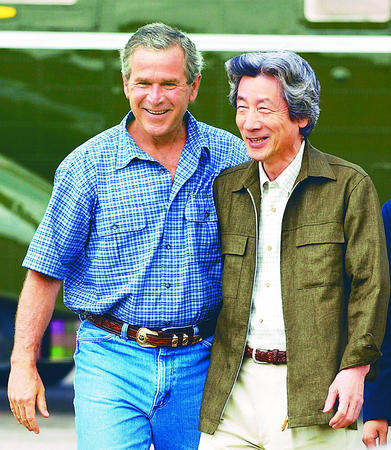
Though the United States at first expressed distaste for Koizumi's diplomacy with North Korea, which was suspected of developing nuclear weapons, Koizumi did not change his direction. The diplomatic methods he used to press his assertions, unlike those his predecessors had traditionally adopted, also garnered popular support.

In another example of his uniqueness, Koizumi supported the U.S.-led invasion of Iraq in 2003, even though France and Germany opposed it. He also dispatched 600 members of the Ground Self-Defense Force to areas considered dangerous, opening up a new frontier in Japan's international cooperation activities.


Another of Koizumi's unique diplomatic style was his annual visit to the war-linked Yasukuni Shrine, despite domestic and foreign opposition. Consequently Chinese and South Korean leaders refused to hold summit talks with him.

The highlight of Koizumi's political drama may have been his showdown with LDP rebels who refused to agree to his postal privatization policy.

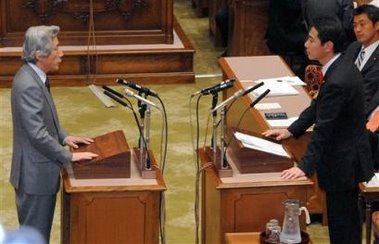
After the postal privatization bills were rejected by 17 votes in the House of Councillors during a 2005 ordinary Diet session, Koizumi immediately dissolved the House of Representatives, saying he would ask for the public's judgment over postal privatization.

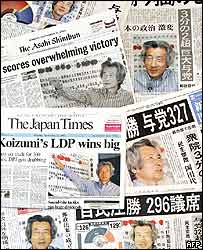
For the lower house election, Koizumi fielded so-called assassins in the constituencies of the rebels who had voted against the postal privatization bills, to prevent them from returning to the Diet. Koizumi's determination to win the political battle, which some people said was overly ruthless, gained the interest and support of the public, including floating voters, and helped the LDP win a historic victory. The postal privatization bills were passed at an extraordinary Diet session after the election, and Koizumi's long-cherished wish was accomplished.

In a November speech, Koizumi spoke about the lower house election in which the rebels were virtually wiped out, saying, "It [the election] changed the LDP dramatically."

(Sep. 19, 2006)

Friday, September 08, 2006

New TOEIC---speaking, writing

New TOEIC to offer speaking, writing tests from next January

It looks like aspects of the Toeic and the iBT Toefl are merging. For further info, you could also look at http://communicate01.googlepages.com/.
It might help make some meaning out of all the chaos.

Dave


Kiyomi Arai Daily Yomiuri Staff Writer

The U.S.-based test organizer Educational Testing Service has announced a new approach in one of its major products--the Test of English for International Communication--beginning in January next year.

The current TOEIC test evaluates the listening and reading skills of test-takers. In addition, ETS will launch TOEIC speaking and writing tests, which will be offered in a package but scored individually.

The new tests' materials will be provided through the Internet, although test-takers will still have to go to authorized testing centers because of the need to confirm their identification.

The speaking test will take 20 minutes and involve 11 questions, while the writing test will take one hour for eight questions. Test-takers will receive separate scores for each test, with additional information provided on their proficiency levels in each area.

During an interview with The Daily Yomiuri following a press conference in Tokyo in mid-July, ETS Assessment Specialist Jessica Reeder said the tests were developed using a cutting-edge ETS method--"advanced measurement design methodology"--to make it clear what level the test-taker has attained.

The method uses a top-down approach: first develop broad ideas about what kind of skills needed to be scored, then devise tasks and finally come up with actual questions. Thus the new tests include new tasks, such as writing an e-mail in response to one presented on the test sheet.

Bhaskar Pant, ETS managing director of Asia-Pacific operations, said the organization started developing the tests a decade ago in response to increasing demand from test-users, who are mainly corporations. "Communicative skill is something that has been recognized by the global marketplace, as English becomes used more and more in e-mail communication and conference calls. Business tasks require speaking and writing skills much more so than before because of the increase of global interaction," he said.

The conventional TOEIC test combined with the new TOEIC speaking and writing tests will evaluate four skills--speaking, listening, writing and reading--just as in the new Internet-based TOEFL test that started recently, also offered by the ETS.

Pant said ETS emphasizes that it is becoming more important for a person to have communicative skills, and both TOEFL and TOEIC tests measure the same four skills, though their concepts and markets differ.

Practice versions of the TOEIC speaking and writing tests are available on the ETS Web site: www.toeic.or.jp/sw/.

(Aug. 31, 2006)

Japan's thought police

BIG BROTHER ALERT
The Rise of Japan's Thought Police

By Steven Clemons
Sunday, August 27, 2006;


Anywhere else, it might have played out as just another low-stakes battle between policy wonks. But in Japan, a country struggling to find a brand of nationalism that it can embrace, a recent war of words between a flamboyant newspaper editorialist and an editor at a premier foreign-policy think tank was something far more alarming: the latest assault in a campaign of right-wing intimidation of public figures that is squelching free speech and threatening to roll back civil society.

On Aug. 12, Yoshihisa Komori -- a Washington-based editorialist for the ultra-conservative Sankei Shimbun newspaper -- attacked an article by Masaru Tamamoto, the editor of Commentary, an online journal run by the Japan Institute of International Affairs. The article expressed concern about the emergence of Japan's strident new "hawkish nationalism," exemplified by anti-China fear-mongering and official visits to a shrine honoring Japan's war dead. Komori branded the piece "anti-Japanese," and assailed the mainstream author as an "extreme leftist intellectual."

But he didn't stop there. Komori demanded that the institute's president, Yukio Satoh, apologize for using taxpayer money to support a writer who dared to question Prime Minister Junichiro Koizumi's annual visits to the Yasukuni Shrine, in defiance of Chinese protests that it honors war criminals from World War II.

Remarkably, Satoh complied. Within 24 hours, he had shut down Commentary and withdrawn all of the past content on the site -- including his own statement that it should be a place for candid discourse on Japan's foreign-policy and national-identity challenges. Satoh also sent a letter last week to the Sankei editorial board asking for forgiveness and promising a complete overhaul of Commentary's editorial management.

The capitulation was breathtaking. But in the political atmosphere that has overtaken Japan, it's not surprising. Emboldened by the recent rise in nationalism, an increasingly militant group of extreme right-wing activists who yearn for a return to 1930s-style militarism, emperor-worship and "thought control" have begun to move into more mainstream circles -- and to attack those who don't see things their way.

Just last week, one of those extremists burned down the parental home of onetime prime ministerial candidate Koichi Kato, who had criticized Koizumi's decision to visit Yasukuni this year. Several years ago, the home of Fuji Xerox chief executive and Chairman Yotaro "Tony" Kobayashi was targeted by handmade firebombs after he, too, voiced the opinion that Koizumi should stop visiting Yasukuni. The bombs were dismantled, but Kobayashi continued to receive death threats. The pressure had its effect. The large business federation that he helps lead has withdrawn its criticism of Koizumi's hawkishness toward China and his visits to Yasukuni, and Kobayashi now travels with bodyguards.

In 2003, then-Japanese Deputy Foreign Minister Hitoshi Tanaka discovered a time bomb in his home. He was targeted for allegedly being soft on North Korea. Afterward, conservative Tokyo Gov. Shintaro Ishihara contended in a speech that Tanaka "had it coming."

Another instance of free-thinking-meets-intimidation involved Sumiko Iwao, an internationally respected professor emeritus at Keio University. Right-wing activists threatened her last February after she published an article suggesting that much of Japan is ready to endorse female succession in the imperial line; she issued a retraction and is now reportedly lying low.

Such extremism raises disturbing echoes of the past. In May 1932, Japanese Prime Minister Tsuyoshi Inukai was assassinated by a group of right-wing activists who opposed his recognition of Chinese sovereignty over Manchuria and his staunch defense of parliamentary democracy. In the post-World War II era, right-wing fanatics have largely lurked in the shadows, but have occasionally threatened those who veer too close to or speak too openly about sensitive topics concerning Japan's national identity, war responsibility or imperial system.

What's alarming and significant about today's intimidation by the right is that it's working -- and that it has found some mutualism in the media. Sankei's Komori has no direct connection to those guilty of the most recent acts, but he's not unaware that his words frequently animate them -- and that their actions in turn lend fear-fueled power to his pronouncements, helping them silence debate. What's worse, neither Japan's current prime minister nor Shinzo Abe, the man likely to succeed him in next month's elections, has said anything to denounce those trying to stifle the free speech of Japan's leading moderates.

There are many more cases of intimidation. I have spoken to dozens of Japan's top academics, journalists and government civil servants in the past few days; many of them pleaded with me not to disclose this or that incident because they feared violence and harassment from the right. One top political commentator in Japan wrote to me: "I know the right-wingers are monitoring what I write and waiting to give me further trouble. I simply don't want to waste my time nor energy for these people."

Japan needs nationalism. But it needs a healthy nationalism -- not the hawkish, strident variety that is lately forcing many of the country's best lights to dim their views.


steve@thewashingtonnote.com


Steven Clemons is director of the American Strategy Program at the New America Foundation and co-founder of the Japan Policy Research Institute.